When to Switch to Winter Tires in Vancouver: BC Highway Regulations for BMW Drivers
When to Switch to Winter Tires in Vancouver: BC Highway Regulations for BMW Drivers
Posted on August 21, 2026
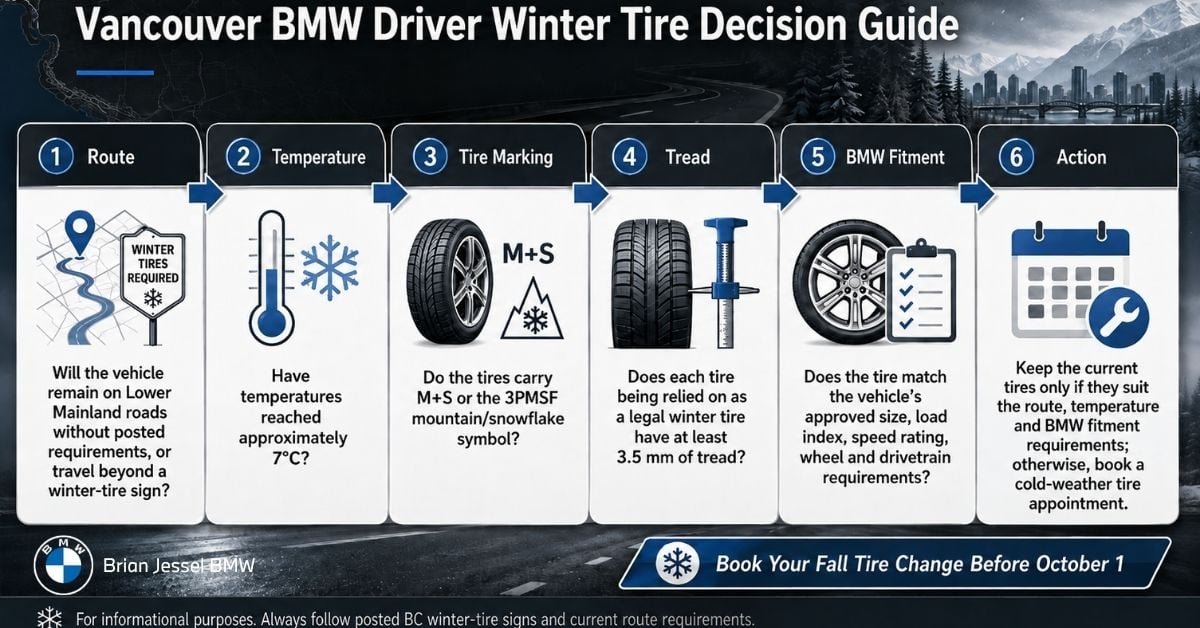
Vancouver BMW drivers should consider changing to cold-weather tires when temperatures reach approximately 7°C and before travelling on a highway where posted winter-tire requirements are in effect. BMW Canada states that summer and standard all-season tire compounds stiffen in colder temperatures, while BMW Approved Cold Weather Wheel Kits use tires made to remain flexible below 7°C.
BC winter tire regulations apply on designated highway sections marked by regulatory signs. Current provincial information states that winter tires are required on most designated routes from October 1 to April 30, while requirements end March 31 on select highways not located through mountain passes or high-snowfall areas.
For a legal BC winter tire, look for either the M+S marking or the 3-peaked mountain and snowflake symbol, commonly called 3PMSF. The tire must also have at least 3.5 mm of tread depth.
[Schedule Your Fall Tire Change at Brian Jessel BMW Service Before October 1]
[View BMW Cold Weather Wheel Packages]
BC Winter Tire Regulations: Legal Rules vs. Vancouver City Driving
BC’s provincial winter-tire rule is based on designated highway sections and posted signs. Many roads in the Lower Mainland are not designated winter-tire routes, but local governments and private roads may set separate requirements.
Drivers must obey the dates printed on regulatory winter-tire signs. The current BC Government route page says most designated routes carry requirements from October 1 to April 30, while select routes outside mountain-pass or high-snowfall areas end March 31. The Province may also restrict travel at other times when road conditions require it.
For Metro Vancouver drivers, the relevant question is not simply whether the vehicle starts within Vancouver city limits. A trip may move from coastal roads without a posted requirement onto designated portions of Highway 99, Highway 1 or another provincial route.
The Malahat is specifically identified by the Province as an example of a South Coast route where winter tires are needed. Drivers should check the current provincial map and roadside signs before leaving.
A driver who continues past a winter-tire sign without the required tires may be prevented from travelling and fined. The current BC Government enforcement page lists a $121 fine when a passenger vehicle is not equipped with winter tires where they are required.
Driving without winter tires does not automatically make a driver responsible for a crash. ICBC states that when winter tires could have helped, not having them may affect whether, or how much, the driver is found responsible.
Keep Reading: BMW Tire Size Guide
The 7°C Rule for BMW Tire Packages in Vancouver
BMW Canada and Brian Jessel BMW identify around 7°C as the key cold-weather tire threshold. Brian Jessel BMW recommends installing BMW Approved Cold Weather Tires before the first signs of winter weather.
At lower temperatures, summer and all-season tire compounds become stiffer, while cold-weather tires remain more flexible.
BMW tire requirements vary by model, model year, wheels, brakes and drivetrain. The correct tire size, load index, speed rating, run-flat specification and wheel fitment should be confirmed before installation.
For xDrive and other all-wheel-drive BMW models, BC guidance recommends four winter tires evenly matched in tread type and depth, since mixing tire patterns, construction or sizes can reduce stability.
The applicable legal end date varies by route. Some requirements end March 31, while others continue until April 30, so drivers should check the posted route dates and consider upcoming travel before changing back.
M+S vs. 3PMSF and BMW Star Approved Winter Tires
Both M+S and 3PMSF tires can meet BC’s legal winter-tire definition when they have at least 3.5 mm of tread. For regular travel in snow, ice or slush, ICBC recommends four matched tires carrying the mountain/snowflake symbol.
M+S is one of the two winter-tire markings accepted under BC rules and is found on many all-season tires. ICBC says M+S tires may suit drivers who encounter winter conditions only occasionally and are prepared to drive with added care.
The 3PMSF or mountain/snowflake designation is tied to a performance-based winter standard. ICBC recommends this tire type for drivers who regularly expect snow, ice and slush or who frequently travel for skiing and other winter activities.
BMW’s Star Mark has a separate purpose. BMW Canada states that Star-marked tires are developed for individual BMW models and designed to work with BMW suspension components and adaptive systems. The Star Mark does not replace BC’s required M+S or mountain/snowflake marking.
Learn More: BMW i3 Tire Size Guide
M+S, 3PMSF and BMW Star Approved Tire Comparison |
|||
| Feature or Standard | M+S | 3PMSF / Mountain-Snowflake | BMW Star Approved |
| BC Winter-Tire Marking | Yes | Yes | No; The Star Mark Alone Is Not a BC Winter Marking |
| Minimum Legal Tread | 3.5 mm | 3.5 mm | 3.5 mm When the Tire Also Qualifies Under BC Winter-Tire Rules |
| Performance Designation | Legally Accepted M+S Designation | Performance-Based Winter Standard | BMW Vehicle-Specific Approval |
| Regular Snow, Ice and Slush | ICBC Says It May Suit Limited Exposure | ICBC Recommends Four Matched Tires | Depends on Whether the Star-Marked Tire Also Carries the Proper Winter Designation |
| BMW-Specific Development | Not Necessarily | Not Necessarily | Yes |
How to Store and Book BMW Tire Packages at Brian Jessel BMW
Brian Jessel BMW currently lists Cold Weather Wheel Kits for a range of BMW models and provides tire installation, balancing, wheel alignment, tread inspection and seasonal tire storage. Exact fitment and kit availability should be confirmed for the individual vehicle.
The current Cold Weather Wheel Package page lists kits by BMW model, wheel size and applicable model year. It also notes restrictions for certain brake packages and performance models, which is why vehicle-specific confirmation is necessary before ordering.
BMW Canada also lists wheel service and storage as part of its retailer-based wheel and tire support. Its current page states that wheels are inspected after a tire change and that storage may be offered through the retailer.
To arrange BMW Service in Vancouver, use the online service-booking option on Brian Jessel BMW’s service page. The live page also lists 604-222-8806 for telephone enquiries and 604-243-4462 for text messages.
Schedule your fall tire appointment before October 1 if you plan to use a designated BC route when the seasonal requirement begins. This gives the service team an opportunity to confirm the correct BMW fitment and have the vehicle ready before the applicable roadside-sign date.
Frequently Asked Questions
BC winter-tire requirements depend on the route, posted dates, tire markings and tread depth. BMW drivers should also consider the approximately 7°C cold-weather threshold and their expected winter travel.
1. Is October too early to put winter tires on?
No. October 1 begins the requirement on designated routes, and BMW Canada uses about 7°C as its cold-weather threshold.
2. What months do you need winter tires in BC?
Most designated routes require them from October 1 to April 30. Requirements end March 31 on select routes outside mountain passes or high-snowfall areas.
3. Do you need winter tires to drive in Vancouver?
Not on every Vancouver road. They are required when a driver enters a posted designated route, while local or private roads may have separate rules.
4. Is it bad to change to winter tires early?
Not necessarily. BMW Canada gives no fixed calendar date; its guidance is based on temperatures reaching approximately 7°C, while BC route requirements begin October .
5. Do I need winter tires for the Sea-to-Sky Highway?
Yes, wherever Highway 99 carries posted winter-tire signs. Check the current South Coast route map, sign dates and road conditions before travelling.
6. Can I legally drive all-season tires on BC highways during winter?
Yes, if they carry the M+S marking, have at least 3.5 mm of tread and meet the posted route requirement. ICBC recommends matched 3PMSF tires for regular snow, ice and slush.
7. What is the difference between BMW Star Approved and standard winter tires?
BMW Star Approved tires are developed for a specific BMW application. They must still carry M+S or 3PMSF and have at least 3.5 mm of tread to meet BC winter-tire rules.