BMW Tire Size Guide: How to Find the Right Tires for Your BMW
BMW Tire Size Guide: How to Find the Right Tires for Your BMW
Posted on June 14, 2026
Vancouver's rain, changing temperatures, potholes, and winter trips along the Sea-to-Sky Highway can all affect tire performance. Choosing the right tire size plays an important role in safety, handling, ride comfort, and year-round driving confidence.
BMW vehicles are engineered around specific tire dimensions, load ratings, and speed ratings. Even small changes can affect steering response, braking performance, xDrive operation, and overall vehicle balance.
At Brian Jessel BMW, tire fitment is one of the most common questions from owners. Whether you drive a BMW X1, X3, X5, i3, or M model, selecting the correct tire size starts with understanding BMW's factory specifications.
How to Read a BMW Tire Size
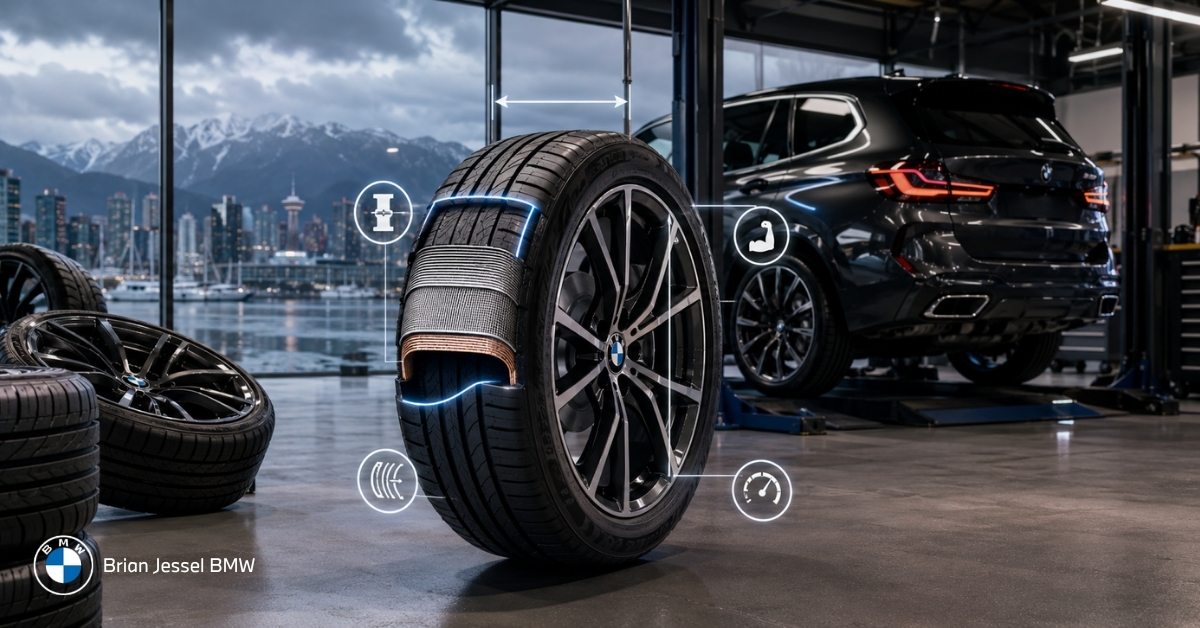
A BMW tire size contains important fitment information. A common example is:
225/45R18 95Y
In this example, 225 is the tire width in millimetres, 45 is the sidewall height as a percentage of tire width, R means radial construction, 18 is the wheel diameter in inches, 95 is the load index, and Y is the speed rating.
Tire width affects road grip, handling response, and hydroplaning resistance. Sidewall height affects both comfort and handling, with lower-profile tires usually giving sharper steering response and taller sidewalls helping absorb rough pavement.
Wheel diameter determines which wheel the tire can be mounted on. An 18-inch tire can only be installed on an 18-inch wheel. Load index and speed rating are equally important because replacement tires should meet the vehicle's original specifications. 2
What Does "R" Mean on BMW Tires?
The "R" stands for radial construction. Nearly every modern BMW tire uses radial construction because it provides a balance of comfort, tread life, handling stability, improved road grip, better fuel efficiency, and consistent performance.
What Is a Load Index?
A load index indicates how much weight a tire can safely support. This becomes especially important on heavier vehicles such as the BMW X5, BMW plug-in hybrids, and BMW electric vehicles. A tire with the correct size but an incorrect load rating may not meet BMW's requirements.
What Speed Rating Does BMW Require?
Speed ratings vary by model and trim level. A BMW X1, BMW X3, BMW X5, BMW i3, and BMW M4 may all require different speed ratings. Always verify the factory specification before purchasing replacement tires.
Where Can You Find Your BMW Tire Size?
The most reliable place to check your BMW tire size is the driver-side door placard. Original tire specifications can typically be found on the vehicle door placard and in the owner's manual.
You can also check the current tire sidewall, but do not rely on it alone. A previous owner may have installed the wrong size, a non-approved tire, or a tire with an incorrect load or speed rating.
The owner’s manual, BMW factory documentation, and a BMW-certified technician are also important sources, especially for xDrive vehicles, M models, plug-in hybrids, electric vehicles, and staggered wheel setups.
Many newer BMW models also allow drivers to access tire and wheel information through the BMW iDrive system. Depending on model and software version, tire specifications, recommended pressures, and tire-monitoring information may be available through the vehicle settings menus.
BMW Technician Insight
Two tires may share the same visible size but have different load indexes, speed ratings, run-flat construction, or BMW Star Mark approval. Before buying replacement tires, confirm the full factory specification, not just the sidewall size.
BMW Tire Size Chart by Model
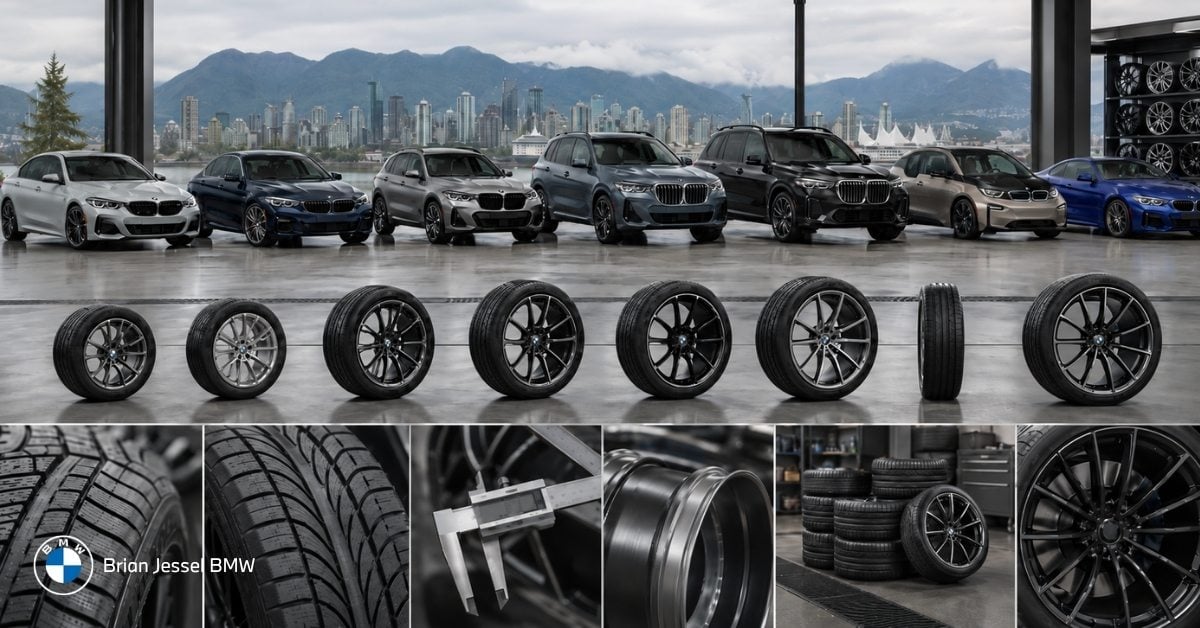
The tables below use BMW Canada / BMW Shop Canada verified fitment examples where available. They are not universal specifications for every BMW. BMW tire sizes vary by model year, trim, wheel package, drivetrain, and equipment.
Always confirm exact tire size using the driver-side door placard, owner’s manual, BMW factory documentation, or Brian Jessel BMW’s service team.
Fitment Note: Tire sizes shown represent common factory fitment examples found on Canadian-market BMW vehicles. Exact specifications vary by model year, trim level, wheel package, and optional equipment.
BMW 3 Series Tire Size Chart
The BMW 3 Series is known for balanced handling and responsive steering. Tire size affects ride comfort, road grip, and steering precision.
| Model | Common Canadian-Market Fitment Examples | Notes |
| BMW 330i / 330i xDrive / M340i / M340i xDrive | 225/50R17 98H | BMW-Approved 17-Inch Winter Package Fitment |
| BMW 330i / 330i xDrive / M340i / M340i xDrive | 225/45R18 95H | BMW-Approved 18-Inch Winter Package Fitment |
| BMW 330i | 245/40R19 98V | BMW-Approved 19-Inch Winter Package Fitment |
For winter driving in Vancouver, many 3 Series owners choose an approved square winter setup. This can improve winter traction and simplify seasonal tire replacement.
BMW 5 Series Tire Size Chart
The BMW 5 Series balances luxury ride quality with athletic handling. Tire selection plays an important role in road comfort and highway stability.
| Model | Common Canadian-Market Fitment Examples | Notes |
| BMW 530i | 245/45R18 | Common 18-Inch Touring Fitment |
| BMW 540i | 245/40R19 | Common 19-Inch Sport Package Fitment |
| BMW M550i | 245/35R20 Front / 275/30R20 Rear | Performance-Oriented Staggered Fitment |
Larger wheel packages often provide sharper steering response but may result in a firmer ride over Vancouver's potholes and uneven pavement.
BMW X1 Tire Size Chart
The BMW X1 remains a popular choice for urban drivers looking for compact SUV versatility and efficient operation.
| Model | Common Canadian-Market Fitment Examples | Notes |
| Earlier X1 Models | 225/50R17 | Common Base Fitment |
| Current X1 Models | 225/55R18 102H | BMW-Approved Winter Package Fitment |
| Optional Wheel Package | 245/45R19 | Larger Wheel Option |
| Optional 20-Inch Wheel Package | 245/40R20 | Available on Select Configurations |
The BMW X1 is well suited to city driving throughout Vancouver, Burnaby, Richmond, and North Vancouver. For many drivers, winter traction and wet-weather grip are more important than maximum tire width.
When selecting replacement tires for an X1, fuel efficiency, road comfort, and cold-weather performance should all be considered alongside tire size.
BMW X3 Tire Size Chart
The BMW X3 is one of the most popular BMW models in Metro Vancouver. It combines SUV practicality with BMW handling and is commonly used for commuting, family travel, ski trips, and highway driving.
Tire selection affects ride comfort, wet-weather traction, braking performance, and xDrive operation. Choosing the correct BMW X3 tire size helps maintain the handling characteristics BMW engineers intended.
| Model | Common Canadian-Market Fitment Examples | Notes |
| BMW X3 xDrive30 | 245/50R19 | Common Standard Fitment |
| BMW X3 M Sport | 255/45R20 Front / 285/40R20 Rear | Performance-Oriented Staggered Fitment |
| BMW X3 Optional 21-Inch Package | 255/40R21 Front / 285/35R21 Rear | Larger Wheel Package |
| BMW X3 Winter Package | Approved 19-Inch Square Setup | BMW-Approved Winter Wheel and Tire Package |
For many Vancouver families, the ideal X3 tire balances highway comfort, wet-weather traction, and winter capability. Drivers who regularly travel to Whistler or the Interior often benefit from a dedicated winter wheel and tire package.
BMW X5 Tire Size Chart
The BMW X5 combines luxury SUV comfort with strong performance and towing capability. Tire fitment plays an important role because of the vehicle's weight, load requirements, and available wheel packages. Tire size affects braking performance, ride quality, winter stability, and load-carrying capability.
| Model | Common Canadian-Market Fitment Examples | Notes |
| BMW X5 xDrive40i | 275/45R20 | Common Standard Fitment |
| BMW X5 Optional 21-Inch Package | 275/40R21 Front / 315/35R21 Rear | Performance-Oriented Staggered Fitment |
| BMW X5 xDrive50e | 275/45R20 or Staggered 21-Inch Setup | Plug-In Hybrid Fitment |
| BMW X5 M60i | 275/40R21 Front / 315/35R21 Rear | Performance-Oriented Fitment |
| BMW X5 M Competition | 295/35R21 Front / 315/30R22 Rear | BMW M-Specific Fitment |
Larger wheels can improve steering response and appearance, but they often produce a firmer ride. Many Vancouver drivers choose a dedicated winter package with a smaller wheel diameter and a taller sidewall for improved winter comfort and snow performance.
BMW i3 Tire Size Chart
The BMW i3 uses one of the most unique tire designs in the BMW lineup. Unlike most vehicles that use wider tires, the i3 was engineered with narrow, low rolling resistance tires. This design helps improve efficiency and driving range.
| Model | Common Canadian-Market Fitment Examples | Notes |
| BMW i3 19-Inch Setup | 155/70R19 Front / 175/60R19 Rear | Most Common Fitment |
| BMW i3 Alternate 19-Inch Setup | 155/70R19 All Around | Available on Select Configurations |
| BMW i3 20-Inch Setup | 155/60R20 Front / 175/55R20 Rear | Optional Wheel Package |
Learn More: BMW i3 Tire Size Guide
Many BMW owners are surprised by the narrow tire width. BMW selected these dimensions to reduce rolling resistance while maintaining predictable handling and braking performance. Installing non-approved tire sizes on an i3 can affect EV range, traction control calibration, and ride quality.
BMW M Models Tire Sizes
BMW M vehicles place greater demands on tires than standard BMW models. Tire fitment directly affects acceleration, braking performance, cornering grip, and steering precision. Most M models use staggered tire setups, with wider rear tires helping deliver power to the road.
| Model | Common Canadian-Market Fitment Examples | Notes |
| BMW M2 | 275/35R19 Front / 285/30R20 Rear | Performance-Oriented Fitment |
| BMW M3 | 275/35R19 Front / 285/30R20 Rear | Current Staggered Performance Configuration |
| BMW M4 | 275/35R19 Front / 285/30R20 Rear | Current Staggered Performance Configuration |
| BMW X5 M | 295/35R21 Front / 315/30R22 Rear | High-Performance SUV Fitment |
Note: BMW M-model tire sizes can vary significantly by model year, Competition package, wheel package, and generation. Always verify exact fitment using BMW factory specifications or the vehicle door placard.
How BMW Tire Sizes Affect Performance and Handling
Tire size influences nearly every aspect of vehicle behaviour. A wider tire increases the tire contact patch, which can improve grip and cornering in dry conditions, but it may also raise road noise and rolling resistance.
Sidewall height affects ride comfort and steering response. Low-profile tires feel more precise in cornering, while taller sidewalls absorb road imperfections better. Wheel weight also matters. Larger wheels can improve appearance and handling feel, but added weight may reduce ride comfort and affect suspension response.
BMW suspension tuning is designed around specific tire dimensions. Changing tire size can affect steering precision, braking performance, and overall balance. Tire size affects cornering stability, steering response, ride comfort, braking performance, road noise, and wet-weather traction.
Because BMW calibrates its suspension and safety systems around specific tire dimensions, staying within approved fitment specifications is generally recommended.
Should You Use Winter Tires on Your BMW in Vancouver?
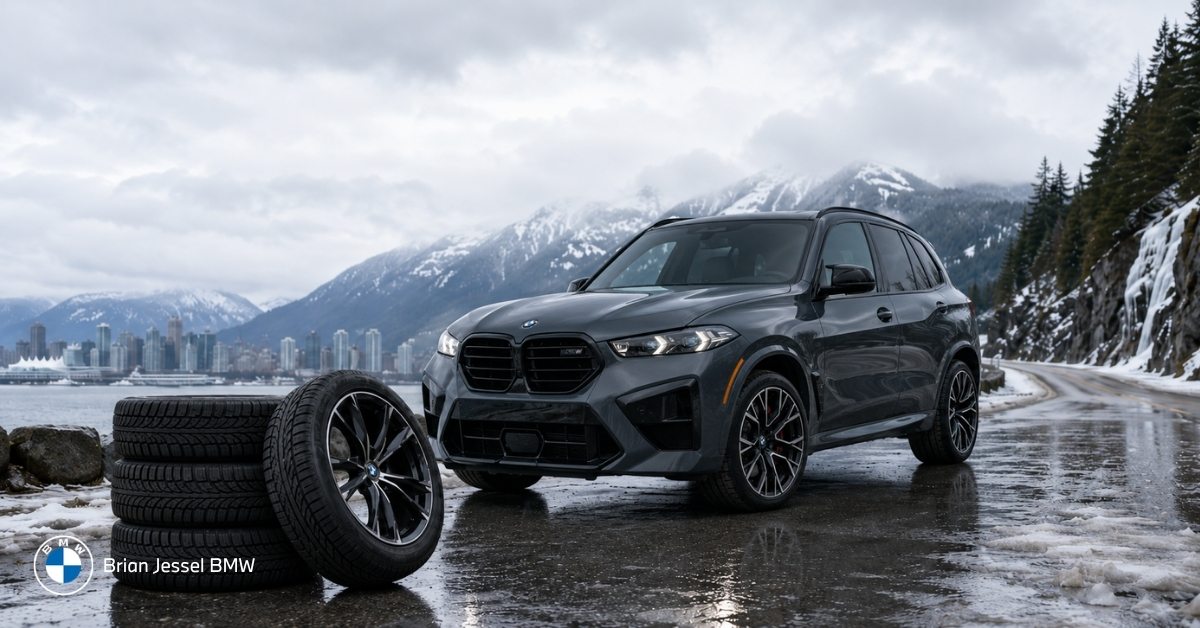
For many Vancouver drivers, winter tires are an important seasonal change. The Lower Mainland sees heavy rain, but winter also brings black ice, slush, mountain snow, and fast-changing temperatures between coastal and higher-elevation areas like the North Shore.
Winter tires use a rubber compound that stays flexible in cold weather, helping maintain grip when all-season tires harden. They improve cold-weather traction, snow and slush handling, braking performance, resistance to hydroplaning, and cornering stability.
In Vancouver, cold wet roads can be as challenging as snow, making winter tires especially useful for maintaining control and shorter stopping distances. This is particularly relevant for travel on the Sea-to-Sky Highway, Highway 1, and mountain routes during winter months.
British Columbia Winter Tire Requirements
British Columbia requires winter tires or chains on many designated routes from October 1 to April 30, although some routes end on March 31 depending on location.
A legal winter tire in British Columbia must display either the M+S (Mud and Snow) designation or the Three-Peak Mountain Snowflake symbol and meet provincial tread-depth requirements.
Drivers who regularly travel mountain routes often benefit from dedicated winter tires carrying the Three-Peak Mountain Snowflake designation. For additional guidance on winter tire selection, seasonal driving considerations, and BMW winter wheel packages, see our BMW Winter Tire Guide.
Run-Flat Tires vs Conventional Tires for BMW Models
Many BMW vehicles are equipped with run-flat tires from the factory. Run-flat tires use reinforced sidewalls that can support the vehicle for a limited distance after air pressure is lost. This allows the driver to reach a repair facility without immediately stopping to change a tire.
Run-flat tires can improve roadside safety by allowing limited continued driving after a loss of air pressure. They also eliminate the need for a spare tire on many BMW models, helping preserve cargo space.
Conventional tires often provide a softer ride, lower replacement costs, and a broader selection of tire options. However, they generally cannot be driven after a puncture without repair or replacement.
The choice between run-flat and conventional tires can affect ride comfort, handling characteristics, emergency mobility, and long-term ownership costs.
Why BMW Uses Run-Flat Tires
BMW's decision to use run-flat tires is tied to vehicle engineering. Suspension tuning, weight distribution, safety systems, and emergency mobility planning all play a role. Many BMW vehicles are calibrated around the characteristics of run-flat construction.
Before switching from run-flat tires to conventional tires, it is worth speaking with a BMW-certified technician. The change may affect ride quality, handling characteristics, tire support equipment, and future service considerations.
BMW Technician Insight
One of the most common mistakes BMW owners make is replacing run-flat tires with non-run-flat alternatives without checking vehicle requirements. Some models can accommodate the change, while others may perform best with the original tire design. A fitment review helps ensure the replacement tire works properly with the vehicle's suspension, xDrive system, and intended driving characteristics.
Can You Change Tire Sizes on a BMW?
Changing tire size is possible on some BMW models, but modifications should remain within BMW-approved fitment parameters. Owners sometimes use plus sizing, which pairs a larger wheel with a lower-profile tire, or minus sizing, which uses a smaller wheel and taller sidewall, often for winter driving.
Any size change should maintain an appropriate overall rolling diameter to help preserve speedometer accuracy, ABS calibration, traction-control operation, and xDrive performance. Wheel clearance, suspension clearance, and the risk of tire rubbing should also be evaluated before changing wheel or tire dimensions.
Vehicles equipped with a Tire Pressure Monitoring System (TPMS) may also require recalibration after tire or wheel changes. Before modifying tire sizes, it is advisable to confirm compatibility using BMW specifications or consult a BMW-certified technician.
What Happens If You Use the Wrong Tire Size on a BMW?
Using the wrong tire size can affect more than appearance. BMW systems such as ABS, traction control, stability control, TPMS, and xDrive are calibrated around specific tire dimensions.
Incorrect sizing can lead to speedometer errors, changes in handling, reduced braking performance, uneven tire wear, and additional drivetrain stress. On BMW electric vehicles, it may also reduce efficiency and driving range.
Best Tire Types for Different BMW Driving Needs
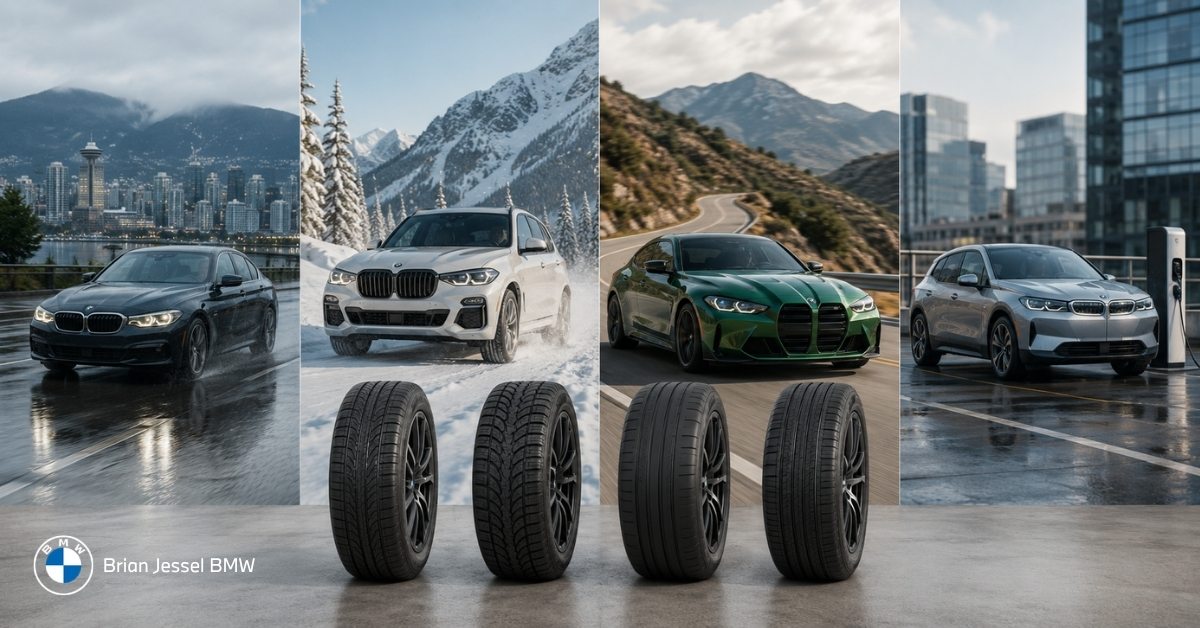
The right tire depends on how and where you drive. A BMW X5 used for family road trips has different requirements than an M4 focused on performance. Road conditions, weather, driving habits, and vehicle type should all influence tire selection.
Best Tires for Vancouver Rain
Vancouver's climate makes wet-weather performance a priority for many drivers. Premium all-season tires with strong hydroplaning resistance, effective water evacuation, and dependable road grip are often well suited to year-round driving in the Lower Mainland.
Best Tires for Snow and Mountain Driving
Drivers who regularly travel to Whistler, the North Shore mountains, or other snow-prone areas should consider dedicated winter tires. Their cold-weather compounds provide stronger traction, braking performance, and control on snow, slush, and icy roads.
Best Performance Tires for BMW M Models
BMW M vehicles are designed for precise handling and high levels of grip. Ultra-high-performance tires are often the preferred choice because they support stronger cornering performance, sharper steering response, and shorter braking distances.
Best Touring Tires for Highway Comfort
Drivers who spend significant time on highways often prioritize comfort and refinement. Touring tires are designed to provide a quieter ride, smooth road manners, long tread life, and dependable wet-weather traction.
Best EV Tires for BMW Electric Vehicles
Electric vehicles such as the BMW i3, i4, i5, i7, and iX often benefit from low rolling resistance tires. These tires are designed to support efficiency while managing the additional weight and instant torque associated with EVs.
How Often Should BMW Tires Be Replaced?
There is no fixed replacement schedule that applies to every BMW owner. Tire life depends on driving habits, road conditions, climate, tire type, alignment condition, and maintenance history. A vehicle driven mainly on Vancouver city streets may wear tires differently than one used primarily for highway travel.
Tread depth is one of the most important indicators of tire condition. As tread wears down, a tire becomes less effective at managing water, slush, and winter road conditions, which can increase braking distances and reduce traction.
Tire age also matters. Over time, rubber compounds harden and may develop cracks, sidewall damage, bulges, vibration, or repeated pressure loss. Uneven wear patterns can also indicate alignment, suspension, or tire pressure issues that should be inspected.
BMW Tire Maintenance Tips for Longer Tire Life
Proper maintenance plays an important role in tire longevity. Maintaining the correct tire pressure helps preserve handling, fuel efficiency, and tread life, while seasonal temperature changes can cause pressure fluctuations throughout the year.
Wheel alignment is equally important, especially on Vancouver roads where potholes and uneven pavement can gradually affect alignment settings. Even minor misalignment can accelerate tire wear and alter steering feel.
Wheel balancing helps reduce vibration and promote even tread wear. Regular inspections can also identify punctures, sidewall damage, and uneven wear before they become more serious problems.
BMW Technician Insight
One of the most common causes of premature tire replacement is poor alignment. Many drivers assume their tires are wearing out naturally when the underlying issue is an alignment setting that has drifted out of specification. Regular inspections can help identify these problems early.
Why OEM BMW Tire Fitment Matters
BMW engineers develop each vehicle around a specific combination of tire dimensions, tread design, sidewall construction, and performance characteristics. As a result, tire fitment affects much more than basic vehicle movement. It influences steering response, ride quality, braking performance, road grip, stability control calibration, and xDrive operation.
OEM-approved tires are selected to complement BMW suspension tuning and vehicle dynamics. This becomes particularly important on performance models, plug-in hybrids, and electric vehicles where tire behaviour directly affects vehicle performance.
BMW Star-Marked Tires and Factory Development
BMW Star Mark tires are developed and approved for specific BMW applications through BMW’s tire-development and validation process. They are designed to work with BMW suspension geometry, braking systems, steering characteristics, and electronic stability systems.
While aftermarket alternatives may physically fit a vehicle, BMW Star Mark tires are engineered to match BMW's original performance targets. For many owners, they remain the closest match to the factory specification when replacement tires are required.
How to Choose the Right BMW Tires for Vancouver Driving
The best tire choice depends on how and where you drive. Urban drivers often prioritize wet-weather traction, ride comfort, and low road noise, while highway commuters may focus more on stability, tread life, and long-distance comfort.
Drivers who regularly travel to Whistler, Squamish, Cypress Mountain, or other mountain destinations should make winter performance a priority. EV owners should pay close attention to rolling resistance and efficiency, while BMW SUV owners often benefit from tires that balance comfort, safety, and year-round capability.
Performance enthusiasts typically place greater emphasis on steering precision, grip, and braking response.
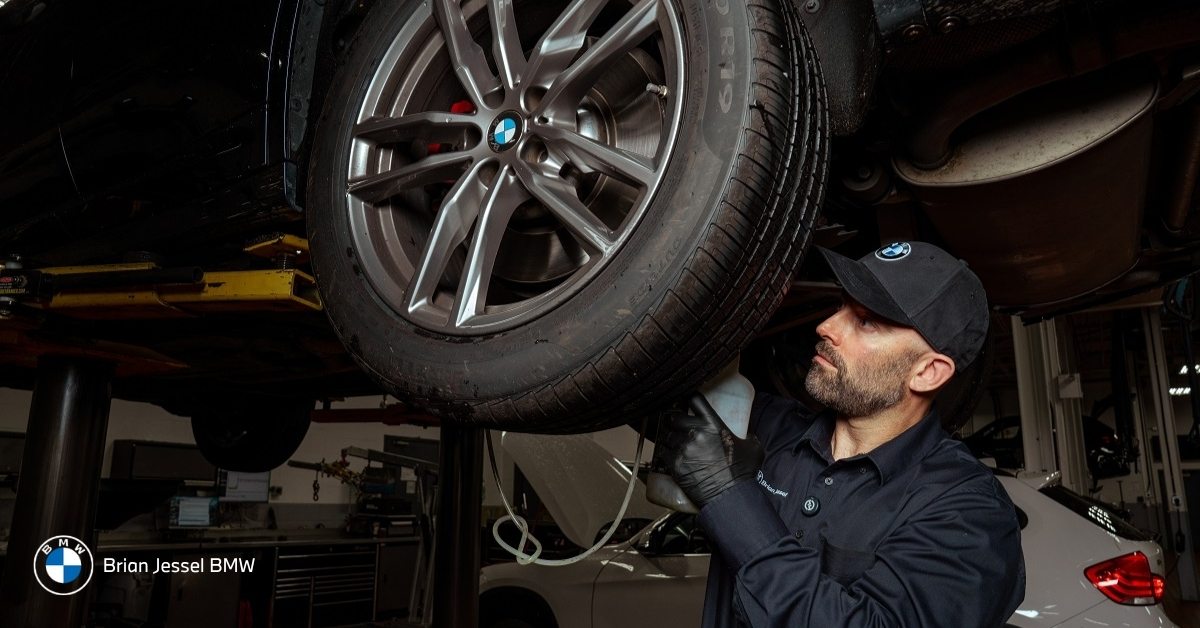
Professional BMW Tire Services at Brian Jessel BMW Vancouver
Selecting the correct BMW tire involves more than matching dimensions. At Brian Jessel BMW, our technicians review tire size, load index, speed rating, run-flat requirements, wheel specifications, and seasonal driving needs before making a recommendation.
This helps ensure replacement tires maintain the vehicle's intended handling characteristics, safety systems, and overall driving performance.
Our team can assist with tire installation, wheel alignment, balancing, seasonal tire storage, tread inspections, winter tire packages, and OEM tire recommendations.
Whether you drive a BMW X1, X3, X5, i3, M model, or another BMW vehicle, we can help confirm factory-correct fitment.
Find the Right BMW Tires with Expert Help in Vancouver
The correct BMW tire size supports safety, steering precision, braking performance, ride quality, and overall driving confidence.
For Vancouver drivers, tire selection should also reflect local conditions. Rain, mountain travel, changing temperatures, and winter weather all influence which tire is best suited to a particular vehicle.
If you're unsure which tire size is correct for your BMW, the team at Brian Jessel BMW can confirm factory specifications, review seasonal options, inspect tire condition, and recommend BMW-approved tires suited to your vehicle and driving needs.
Disclaimer: Vehicle-specific tire fitment should always be confirmed using the driver's door placard, BMW owner's documentation, BMW factory fitment records, or a BMW-certified technician. Tire specifications may vary between model years, trims, wheel packages, xDrive configurations, and regional markets.
FAQs
1. What tire size does a BMW X3 use?
BMW X3 tire sizes vary by model year and wheel package. Common examples include 245/50R19, 255/45R20 front with 285/40R20 rear, and larger optional configurations. Always verify the exact specification for your vehicle.
2. How do I check my BMW tire size?
The most reliable source is the driver-side door placard. You can also check the tire sidewall, owner's manual, BMW iDrive system, or consult a BMW-certified technician.
3. Can I put bigger tires on my BMW?
In some cases, yes. However, rolling diameter, wheel clearance, load ratings, speed ratings, and xDrive compatibility should be reviewed before changing tire size.
4. Can I use different tire sizes on my BMW?
Some BMW models use factory staggered setups with different front and rear tire sizes. Outside of approved configurations, mixing tire sizes is generally not recommended.
5. Are BMW run-flat tires necessary?
Many BMW models are designed around run-flat tire technology. While alternatives may be available, compatibility should be reviewed before making a change.
6. What happens if I install the wrong tire size?
The wrong tire size can affect speedometer accuracy, handling stability, braking performance, traction control systems, xDrive operation, fuel economy, and EV range.
7. What are BMW Star-Marked tires?
BMW Star Mark tires are manufacturer-approved tires that have undergone BMW-specific testing and development.
8. How do I read BMW tire numbers?
A tire size such as 225/45R18 identifies tire width, sidewall height, construction type, and wheel diameter. Additional markings indicate load index and speed rating.
9. Can larger tires damage BMW xDrive systems?
Incorrect tire circumference can place additional stress on xDrive components. Proper fitment is important for maintaining drivetrain calibration.
10. How often should BMW tires be replaced?
Replacement depends on tread depth, age, wear patterns, condition, and driving habits. Regular inspections remain the best way to determine when replacement is necessary.
Explore Latest Models Here: 2026 BMW Cars, 2025 BMW Cars, BMW Gas Vehicles, BMW Electric Car, BMW M Series for Sale, BMW Luxury Line for Sale, BMW Convertible, 2025 BMW 5 Series 530i xDrive, 2024 BMW X3 M40i xDrive, BMW X Series Comparison