BMW i3 Tire Size Guide: Choosing the Best Tires for EV Performance
BMW i3 Tire Size Guide: Choosing the Best Tires for EV Performance
Posted on August 17, 2026
The BMW i3’s tall, narrow tires are among its most recognizable engineering details. They were developed alongside the electric powertrain, lightweight body structure, regenerative braking system, and city-focused chassis rather than selected only for appearance.
For Canadian owners, correct replacement depends on model year, trim, axle position, wheel package, and original factory equipment. This guide covers the original BMW i3 hatchback (I01), including the Range Extender and i3s. It does not cover the new Neue Klasse BMW i3 Sedan, whose Canadian deliveries are expected in the first half of 2027.
Common Canadian configurations include 155/70R19 on all four wheels, 155/70R19 front with 175/60R19 rear, 155/60R20 front with 175/55R20 rear, and the wider i3s combination of 175/55R20 front with 195/50R20 rear. The correct choice depends on the vehicle and wheel package, so confirm the tire-information placard and VIN before ordering.
Disclaimer: This article provides Canadian-market reference information but does not replace the tire-information placard, owner documentation, VIN-based BMW records, or an inspection by a qualified tire technician. Specifications can vary by production date, optional wheel package, previous modifications, and superseded parts. Confirm the complete tire and wheel specification before purchase or installation.
What Is the Correct BMW i3 Tire Size?
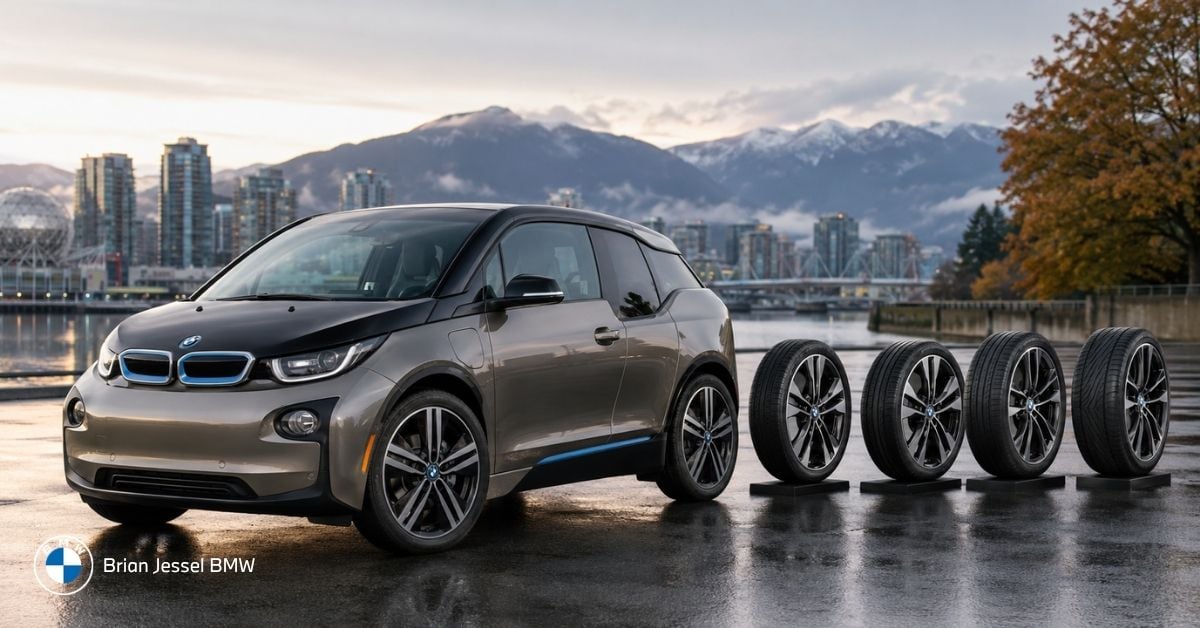
BMW i3 tire size is not universal. Canadian factory configurations include square and staggered 19-inch layouts, an optional 20-inch i3 package, and a wider 20-inch i3s setup. Confirm the driver-side tire-information placard and VIN record before ordering. General tire notation is covered in the BMW tire size guide.
BMW i3 Tire Size Overview by Factory Configuration |
|||
| BMW i3 Configuration | Front Tire Size | Rear Tire Size | Wheel Size |
| i3 Square Setup | 155/70R19 | 155/70R19 | 19 Inches |
| i3 Staggered Setup | 155/70R19 | 175/60R19 | 19 Inches |
| i3 Optional Setup | 155/60R20 | 175/55R20 | 20 Inches |
| i3s Setup | 175/55R20 | 195/50R20 | 20 Inches |
Note: A square setup uses matching tire dimensions on both axles. A staggered setup has wider rear tires and wheels, preventing standard front-to-rear rotation. Tire dimensions alone do not confirm compatible wheel width, offset, load index, speed rating, or axle placement.
BMW i3 Tire Size Chart by Model Year and Factory Configuration
BMW Canada’s archived product information provides detailed Canadian wheel-and-tire specifications for several i3 model years, particularly from 2017 through 2020. Where a complete Canadian factory wheel schedule is not available from the cited documentation, the chart identifies that limitation rather than applying specifications from another model year.
Canadian BMW i3 Tire Size Chart by Model Year |
||||
| Model Year | Canadian Model or Package | Front Tire Size | Rear Tire Size | Wheel Size |
| 2014 Launch | i3 Standard | 155/70R19 | 155/70R19 | 19 Inches |
| 2014 Launch | Optional Wheel Package | Confirm by VIN | Confirm by VIN | 20 Inches |
| 2015–2016 | Confirm Original Canadian Configuration | Verify Tire Placard and VIN-Based BMW Specification | Verify Tire Placard and VIN-Based BMW Specification | Verify Original Wheel Package |
| 2017 | i3 Standard | 155/70R19 | 155/70R19 | 19 Inches |
| 2017 | i3 Range Extender Standard | 155/70R19 | 175/60R19 | 19 Inches |
| 2017 | i3 or Range Extender Optional | 155/60R20 | 175/55R20 | 20 Inches |
| 2018–2020 | i3 Standard | 155/70R19 | 155/70R19 | 19 Inches |
| 2018–2020 | i3 Range Extender Standard | 155/70R19 | 175/60R19 | 19 Inches |
| 2018–2020 | i3 Optional | 155/60R20 | 175/55R20 | 20 Inches |
| 2018–2020 | i3s or i3s Range Extender | 175/55R20 | 195/50R20 | 20 Inches |
| 2021 | Confirm Original Canadian Configuration | Verify Tire Placard and VIN-Based BMW Specification | Verify Tire Placard and VIN-Based BMW Specification | Verify Original Wheel Package |
Disclaimer: The 2014 Canadian launch information confirms standard 19-inch 155/70 tires and optional 20-inch wheels but does not state the optional tire dimensions. A 155/70R19 88Q Original BMW winter assembly is listed for the 2021 BMW i3, but a winter replacement assembly should not be presented as the complete 2021 factory summer or all-season specification.
Why Does the BMW i3 Use Narrow Tires?
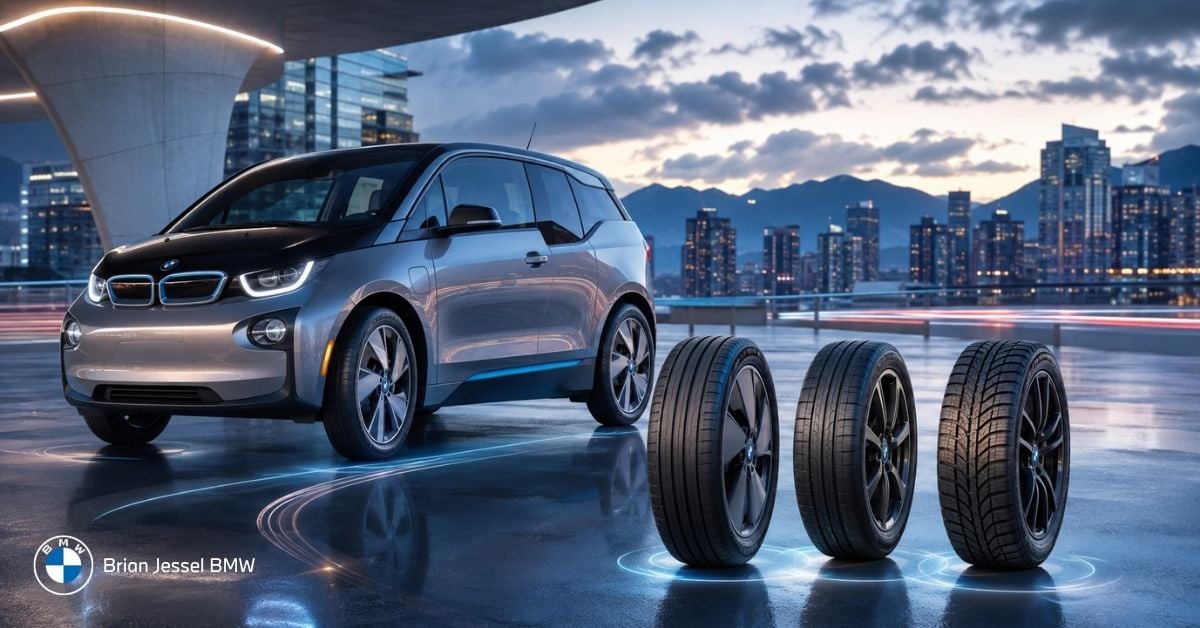
The i3’s tire shape supports its electric-car layout rather than following conventional compact-car sizing. BMW planned wheel diameter, tire width, vehicle weight, steering geometry, energy consumption, and regenerative-braking behaviour as related parts of the chassis.
How BMW i3 Tire Size Supports EV Efficiency
BMW states that the original 155/70R19 tire combines low rolling resistance with a contact area comparable to that of a conventional 16-inch tire. Reduced deformation and drag leave more battery energy available for movement instead of losing it as heat as the tire repeatedly bends against the road.
How Narrow Tires Affect BMW i3 Handling
The tall tire shape creates a long contact patch despite its limited width. Rear-wheel drive and near-even weight distribution support predictable steering. Nineteen-inch tires generally provide greater sidewall compliance, while the lower-profile 20-inch combinations usually produce a firmer ride and more immediate steering response.
Why BMW Chose a Unique Tire Design for the i3
The i3 combined an aluminium chassis module, a carbon-fibre-reinforced plastic passenger cell, regenerative braking, and compact exterior dimensions. Narrow tires helped limit rolling losses and preserve a tight turning circle, making their unusual shape part of the vehicle’s electric engineering rather than a styling decision.
Best Tires for BMW i3 Performance and Efficiency
Tire selection must account for dimensions, axle position, load and speed ratings, wheel width, intended season, and current Canadian availability. The best tire is not determined by brand name alone; it is the correctly rated tire that matches the vehicle’s factory specification and the owner’s driving conditions.
Best Summer Tires for BMW i3
The Bridgestone Ecopia EP500 is a well-known i3-specific summer-oriented option rather than a universal “best” tire for every vehicle. Bridgestone states that it was engineered to reduce rolling resistance and wasted energy. Confirm the exact width, axle position, load rating, speed rating, BMW approval, and current Canadian supply before ordering.
Best All-Season Tires for BMW i3
The Bridgestone Ecopia EP600 is an i3-specific all-season example listed by Bridgestone. It may suit mild Lower Mainland use focused on rain and cool pavement, but it should not be treated as equal to a dedicated winter tire for regular snow, ice, or mountain travel. BMW also works with Bridgestone, Continental, Michelin, and Pirelli on Star-marked tires, although exact i3 fitments and Canadian availability vary.
Best Winter Tires for BMW i3 in Vancouver
Drivers travelling to Whistler, the Interior, ski areas, or signed mountain routes should choose four evenly matched winter tires, preferably carrying the three-peak mountain snowflake symbol. BMW Canada lists an Original BMW 155/70R19 88Q winter wheel-and-tire assembly for the 2021 i3, but compatibility with a particular i3 or i3s must be confirmed by VIN.
Can You Change the BMW i3 Tire Size?
Wider tires may appear attractive, while a square winter package can simplify seasonal service. Either change must be treated as a complete wheel-and-tire decision rather than a substitution based only on similar-looking sidewall numbers.
Is Upsizing BMW i3 Tires Recommended?
Upsizing outside a BMW-listed package is generally not recommended. A tire may mount while having the wrong diameter, rim width, offset, load rating, or clearance. It may also add rotating mass. Have a BMW-certified technician check the complete combination against the VIN before installation.
Potential Effects of Changing BMW i3 Tire Size
Changing overall tire diameter can affect indicated vehicle speed, rolling circumference and the operation of systems that use wheel-speed information, including ABS, stability control and traction control. Different wheel-and-tire combinations can also affect clearance, steering response, ride quality, energy consumption and range. Replacement wheels must also remain compatible with the vehicle’s tire-pressure monitoring hardware. No single range-loss percentage applies to every replacement tire.
OEM vs Aftermarket BMW i3 Tire Sizes
Aftermarket tires can be suitable when size, service description, construction, wheel compatibility, and axle position match the vehicle. BMW Star-marked tires receive model-specific development, but the marking alone does not confirm every i3 fitment. The complete specification and VIN still require checking before installation.
How BMW i3 Tire Size Affects EV Range and Battery Efficiency
The electric motor must overcome tire resistance whenever the vehicle moves. Width, compound, casing, tread, wheel weight, pressure, ambient temperature, and road surface all matter, so equal nominal sizes do not necessarily produce equal energy consumption.
Rolling Resistance and Energy Consumption
Each tire flexes as it enters and leaves the road-contact area, turning some energy into heat. Low-rolling-resistance i3 tires are built to limit that loss while supporting grip and load capacity. A replacement with matching dimensions but different construction may still require more battery energy.
Tire Width and Driving Range
Wider tires can add dry-road grip, but they may also increase rolling resistance, aerodynamic drag, and rotating weight. BMW selected separate widths for the i3 and i3s chassis. Range-conscious owners should stay with an approved size and compare full tire specifications instead of width alone.
Tire Pressure and BMW i3 Efficiency
There is no universal BMW i3 tire-pressure figure. Use the cold values on the driver-side tire-information placard. Transport Canada states that pressure can fall by about 7 kPa, or 1 psi, for every 5°C temperature decrease, making monthly checks particularly important during colder Vancouver weather.
BMW i3 Tire Maintenance Tips for Longer Tire Life
Because BMW i3 tire sizes can be harder to source, routine care helps owners avoid sudden replacement needs. Pressure, tread depth, wheel alignment, driving conditions, and seasonal storage all influence wear and useful tire life.
Recommended BMW i3 Tire Pressure
Check every tire cold at least monthly, after large temperature changes, and before highway or mountain travel. Follow the placard, not the sidewall maximum. Underinflation increases flex and heat; overinflation reduces the useful contact area and can cause a harsher ride and centre-tread wear.
Tire Rotation Considerations for BMW i3
A square 155/70R19 setup may allow front-to-rear rotation when wheel specifications and tread direction match. Staggered 19- and 20-inch packages cannot use normal front-to-rear rotation because axle sizes differ. Alignment and wear inspections are therefore especially important on staggered i3 and i3s models.
Signs It Is Time to Replace BMW i3 Tires
Replace tires at the wear indicators or when cuts, bulges, cracking, exposed material, repeated pressure loss, or uneven wear appears. On signed B.C. winter routes, a legal passenger tire needs at least 3.5 millimetres of tread and an M+S or three-peak mountain snowflake marking.
BMW i3 Tire Services at Brian Jessel BMW Vancouver
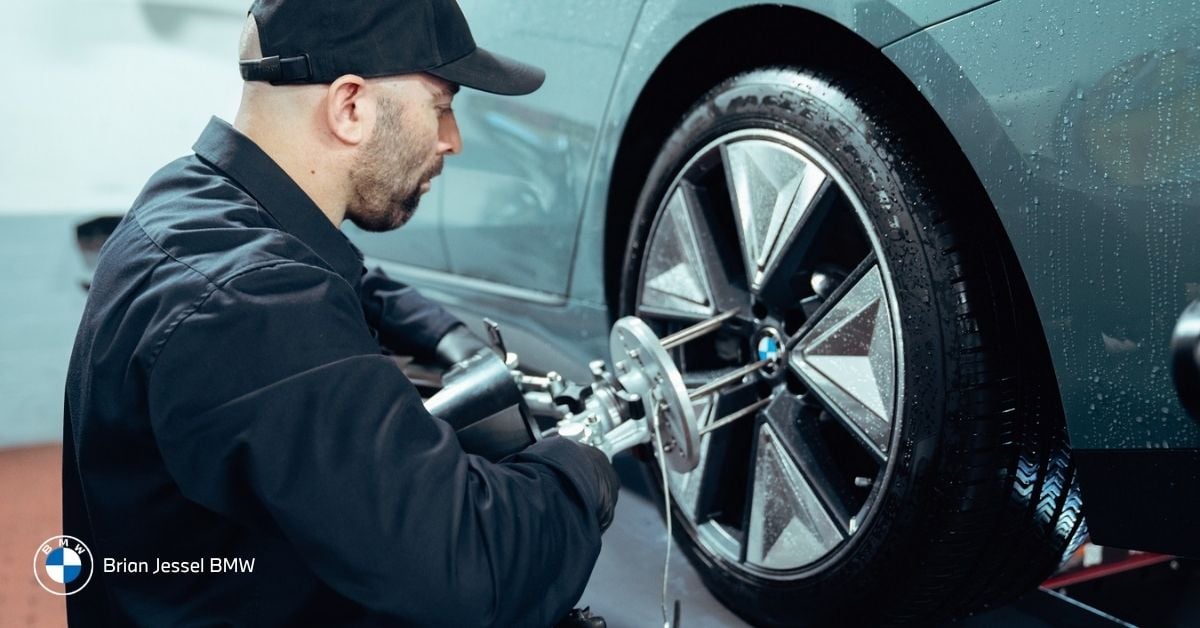
Correct BMW i3 tire service begins with the VIN, original wheel package, and front-to-rear axle layout. Brian Jessel BMW can confirm factory fitment, inspect tread depth and uneven wear, and advise on BMW-approved replacement tires or seasonal wheel packages suited to Vancouver and Lower Mainland driving.
This is particularly useful for the i3 because its narrow dimensions, staggered configurations, and limited tire selection leave less room for fitment errors. The Vancouver service centre lists more than 40 certified, factory-trained technicians, Original BMW parts and accessories, BMW-approved diagnostic tools and specialized equipment. Eligible Original BMW Parts installed by an authorized BMW Retailer may also carry applicable parts-and-labour warranty coverage, subject to BMW Canada’s warranty terms.
Schedule a BMW i3 tire inspection or service appointment to confirm the correct size, tire condition, and seasonal setup before ordering a replacement set.
Choosing the Right BMW i3 Tires for Vancouver Driving Conditions
Local needs depend on where the vehicle travels. Lower Mainland commuting places strong demands on wet grip and water evacuation, while Sea-to-Sky, ski-area, and Interior trips add colder pavement, slush, snow, ice, and signed winter routes.
B.C. requires legal winter tires on most designated routes from October 1 to April 30, although requirements on selected routes end March 31. M+S is the minimum legal marking when paired with at least 3.5 millimetres of tread, while the province recommends three-peak mountain snowflake tires and four evenly matched winter tires.
Many coastal Lower Mainland roads do not require winter tires, but drivers remain responsible for equipping the vehicle for actual conditions.
Before buying, ask a BMW service advisor to confirm tire size, axle position, rim width, service description and winter-package compatibility. For related information, see the BMW tire size guide and BMW-approved cold-weather wheel packages.
FAQs
1. What is the standard BMW i3 tire size?
A common Canadian fitment is 155/70R19 on all four wheels. Some Range Extender models use 155/70R19 front and 175/60R19 rear. Check the vehicle placard before ordering.
2. Does every BMW i3 use the same tire size?
No. Size varies by model year, i3 or i3s trim, Range Extender equipment, and wheel package. Load and speed ratings must also match the vehicle.
3. Can I install wider tires on a BMW i3?
Only with an approved wheel-and-tire package. Wider tires can affect clearance, steering, ride quality, energy use, and electronic systems.
4. What are the best winter tires for a BMW i3?
Choose four matched three-peak mountain snowflake tires in a BMW-approved size. Confirm VIN fitment, production date, availability, and i3s compatibility before purchase.
5. How often should BMW i3 tires be replaced?
There is no fixed kilometre interval. Replace them based on tread depth, age, cracking, damage, pressure loss, and uneven wear.
6. Do BMW i3 tires affect driving range?
Yes. Rolling resistance, pressure, width, tread, wheel weight, temperature, and road conditions can affect battery efficiency and driving range.
7. What tire pressure should a BMW i3 use?
Use the cold pressure shown on the driver-side tire-information placard. Front and rear values may differ, and the sidewall maximum is not the recommended vehicle setting.
Explore Latest Models Here: BMW iX3, 2027 BMW i3 Sedan (NA0), 2026 BMW Cars, 2025 BMW Cars, BMW Gas Vehicles, BMW EV Lineup 2026, BMW M Series for Sale, BMW Luxury Line for Sale, BMW Convertible, BMW M3 G80, New BMW Technologies 2026