2027 BMW iX3 vs. Mercedes GLC EV: Luxury Electric SUV Comparison for Vancouver Drivers
2027 BMW iX3 vs. Mercedes GLC EV: Luxury Electric SUV Comparison for Vancouver Drivers
Posted on October 21, 2026
The 2027 BMW iX3 50 xDrive and electric Mercedes-Benz GLC take different approaches to the premium electric SUV. BMW has confirmed a $75,900 Canadian starting MSRP, up to 698 km of NRCan-certified range and 400 kW DC charging. Mercedes-Benz Canada lists 483 hp, 330 kW charging and an available 39.1-inch MBUX Hyperscreen. Vancouver buyers can read the Brian Jessel BMW iX3 review or check new BMW inventory.
The iX3 50 xDrive is the first series-production model from BMW’s Neue Klasse generation and comes with two electric motors and standard xDrive all-wheel drive. Mercedes-Benz Canada currently presents its competitor as the 2027 Electric Mercedes-Benz GLC SUV. Mercedes-Benz Canada has not yet published Canadian pricing or a Canadian-certified range for the GLC, so those figures remain pending. 2 3
BMW refers to its SUVs as Sport Activity Vehicles (SAVs), emphasizing performance and on-road dynamics. For clarity, this guide uses “SUV”, the term most drivers recognize, when discussing BMW’s off-road-capable models.
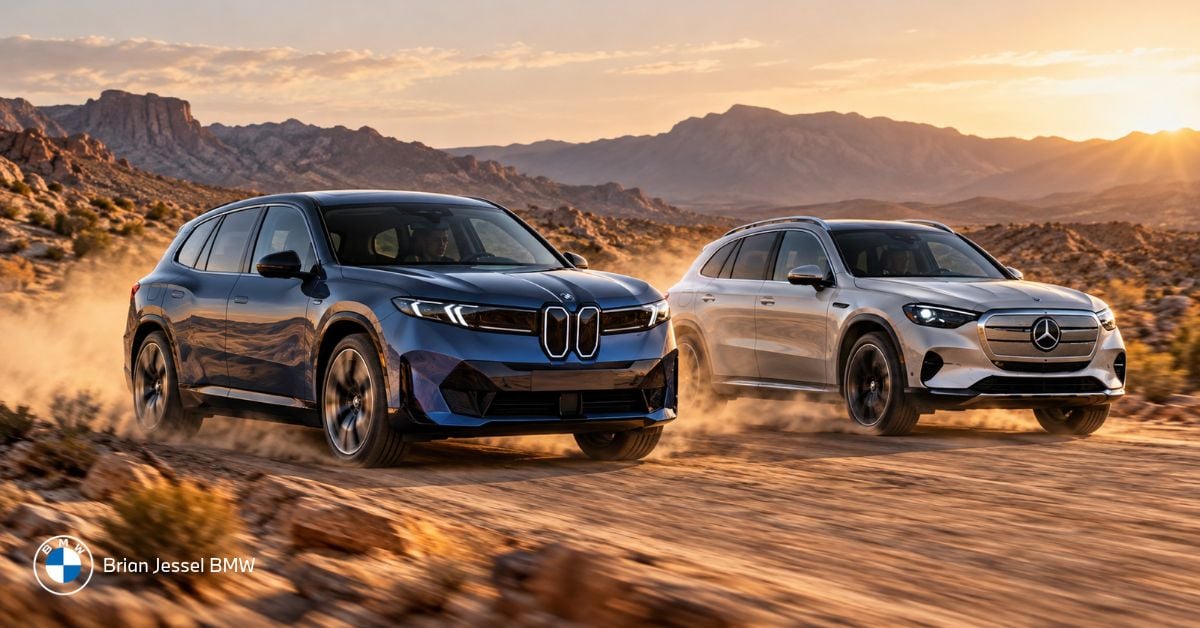
Quick Answer: BMW iX3 vs. Mercedes GLC EV Head-to-Head
- BMW has the higher published maximum DC charging rate: 400 kW versus 330 kW. 1 2
- Mercedes has the higher published horsepower figure: 483 hp versus BMW’s estimated 463 hp. 2
- BMW currently has more finalized Canadian purchase data, including MSRP and an NRCan-certified range figure. 1
2027 BMW iX3 vs. Mercedes GLC EV: Canadian Specs Comparison |
||
| Specification | 2027 BMW iX3 50 xDrive | 2027 Electric Mercedes-Benz GLC SUV |
| Canadian Starting MSRP | $75,900 CAD | Not Yet Published in Canada |
| Published Battery Capacity | 108.7 kWh Usable Energy | 94 kWh Lithium-Ion Battery Capacity |
| Drivetrain | Two Electric Motors; Standard xDrive AWD | Dual-Motor 4MATIC All-Wheel Drive |
| System Power | 463 hp, Estimated by BMW | 483 hp |
| Peak Torque | 476 lb-ft | 590 lb-ft |
| 0 to 100 km/h | 4.9 Seconds, Estimated by BMW | 4.3 Seconds, Manufacturer-Stated |
| Maximum DC Charging Rate | 400 kW | 330 kW |
| 10 to 80% DC Charging Time | As Little as 21 Minutes, BMW Estimate | 22 Minutes Under Specified Conditions |
| Published Driving Range | Up to 698 km, NRCan-Certified | 568–715 km, Manufacturer-Listed; NRCan-Certified Figure Not Confirmed |
| Main Display Technology | BMW Panoramic Vision and 17.9-Inch Central Display | Available 39.1-Inch MBUX Hyperscreen |
| Rear Cargo Space | 520 L; Up to 1,750 L with Rear Seats Folded | 570 L; 1,220 L With Rear Seats Folded |
| Front Storage | 58 L | 128 L |
BMW describes the iX3 battery as providing 108.7 kWh of usable energy. Mercedes-Benz Canada lists 94 kWh lithium-ion battery capacity without identifying that figure as usable energy. The two figures therefore should not be treated as a direct usable-capacity comparison. 2 5 9
Learn More: BMW ix3 vs Tesla Model Y, Volvo EX60 vs BMW iX3, BMW iX3 vs iX in 2026
BMW iX3 vs. Mercedes GLC EV Price & Canadian Value
- The 2027 BMW iX3 50 xDrive starts at $75,900 CAD. 1
- Mercedes-Benz Canada has not yet published a Canadian MSRP for the electric GLC. 2
- B.C. applies graduated PST rates to qualifying zero-emission passenger vehicles based on vehicle value. 6
BMW iX3 Pricing & Standard Luxury Equipment
BMW Group Canada confirmed the $75,900 CAD starting MSRP on May 6, 2026. Canadian sales begin in fall 2026, and the iX3 50 xDrive has an NRCan-certified range of up to 698 km. 1
The iX3 uses two Gen6 electric motors and comes with intelligent BMW xDrive all-wheel drive as standard. Its Panoramic iDrive interface combines BMW Panoramic Vision with a 17.9-inch Central Display. 3 4
The panoramic glass roof and BMW 3D Head-Up Display are optional. Buyers should therefore check the equipment fitted to the exact vehicle they are considering. 4
Mercedes GLC EV Pricing & Options
Mercedes-Benz Canada has not yet published a Canadian starting MSRP for the 2027 electric GLC. Until Canadian pricing is released, there is no reliable basis for stating that either SUV will cost less in an equivalent configuration.
Available equipment listed by Mercedes-Benz Canada includes the 39.1-inch MBUX Hyperscreen, SKY CONTROL panoramic roof, Burmester audio systems, DIGITAL LIGHT headlights and several MB.DRIVE assistance packages. Final Canadian package pricing is not currently shown. 2
B.C.’s current ZEV passenger-vehicle PST schedule uses graduated rates based on vehicle value and remains in effect until February 22, 2027. Buyers taking delivery after that date should check the rules then in force. 6
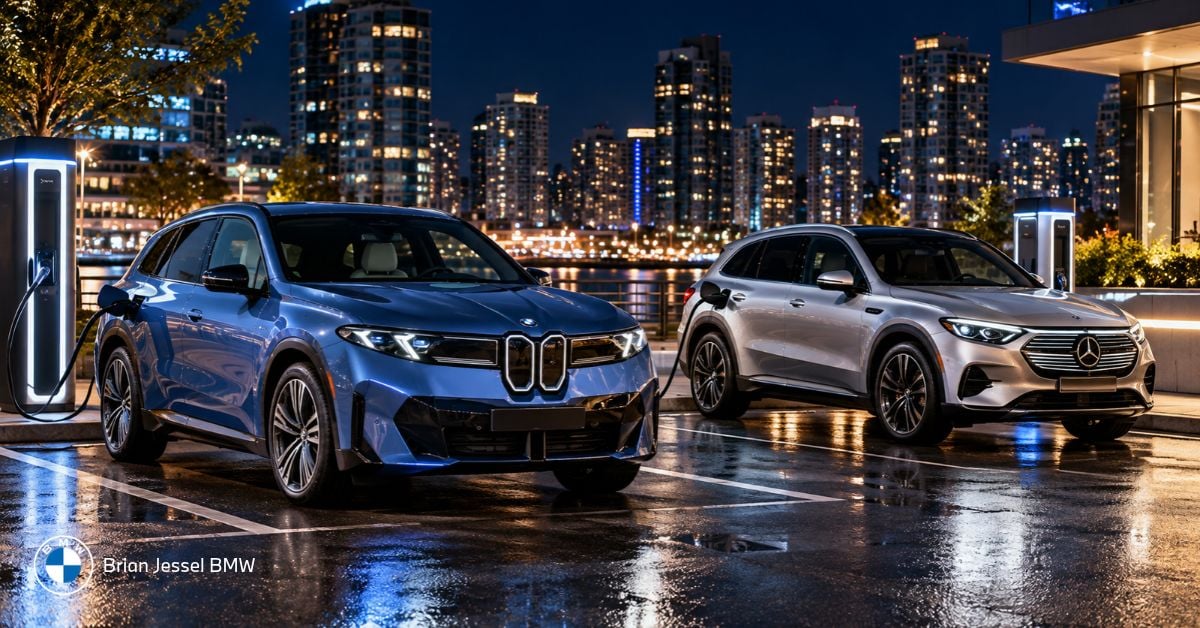 Range, Battery & Charging Speed
- BMW’s Canadian range is NRCan-certified at up to 698 km. 1
- Mercedes-Benz Canada lists a driving-range span of 568–715 km, but a directly comparable NRCan-certified figure has not been established. 9
- Maximum published DC charging rates are 400 kW for BMW and 330 kW for Mercedes-Benz. 1
BMW 400 kW vs. Mercedes 330 kW Charging
The BMW iX3 uses an 800 V electrical system and supports up to 400 kW DC charging. BMW estimates that charging from 10% to 80% can take as little as 21 minutes at a suitable high-powered station, while noting that official charging-time results are not yet available. 3 4
Mercedes-Benz Canada lists a maximum DC charging rate of 330 kW and an estimated 22-minute charging time from 10% to 80% at a compatible 800V charging station. Charging at a 400V station is limited to a published maximum of 100 kW. Actual charging times depend on charging conditions and equipment. 9
The iX3 therefore has the higher published maximum charging-power figure. Actual charging speed still varies with the charger, battery temperature, state of charge and other conditions.
BC Range and Winter Driving
BMW's up-to-698-km range is NRCan-certified using the EPA cycle. Mercedes-Benz Canada currently lists 568–715 km for the GLC 400 4MATIC Electric, but a directly comparable Canadian-certified figure has not been confirmed. The published figures therefore do not establish a definitive range winner. Actual range in B.C. will also depend on weather, speed, elevation, tires and driving conditions.
On trips toward Squamish or Whistler, temperature, elevation, cabin heating, speed and road conditions can change energy use. Natural Resources Canada states that EVs can lose 25% to 30% of their range in extreme cold temperatures. That is a general EV figure, not a model-specific estimate for either SUV. 7
B.C. requires winter tires or chains on most designated routes from October 1 to April 30, with a March 31 end date on selected highways. Drivers heading beyond the coastal Lower Mainland should check posted requirements for their route. 8
Performance, Dynamics & Chassis Control
- Power: Mercedes-Benz Canada lists 483 hp and 590 lb-ft, compared with BMW's estimated 463 hp and published 476 lb-ft. 4 9
- Acceleration: Mercedes-Benz Canada lists 4.3 seconds from 0–100 km/h, compared with BMW's estimated 4.9 seconds. 4 9
- Chassis Control: BMW uses Heart of Joy integrated controls, while Mercedes-Benz offers 4.5-degree rear-axle steering. 2 3
Horsepower, Torque & Acceleration
BMW Canada lists 463 hp, 476 lb-ft of torque and an estimated 4.9-second 0-to-100 km/h time for the iX3 50 xDrive. Top speed is listed at 210 km/h. 4
Mercedes-Benz Canada lists 483 hp, 590 lb-ft of torque and a manufacturer-stated 4.3-second 0–100 km/h time for the GLC 400 4MATIC Electric SUV. Its listed top speed is 200 km/h. 9
On the published figures, the Mercedes has higher horsepower and torque and a quicker 0–100 km/h time than the BMW iX3 50 xDrive's estimated 463 hp, 476 lb-ft and 4.9 seconds. These specifications do not establish which SUV provides the more engaging driving experience; that requires comparable road testing.
Heart of Joy vs. Rear-Axle Steering
BMW’s Heart of Joy controls drivetrain, braking, energy recuperation and steering functions through a central high-performance computer. BMW Group Canada says it processes information up to ten times faster than conventional control units and works with BMW Dynamic Performance Control software. 3
BMW says this arrangement is designed to reduce corrective inputs and support a precise, stable line through corners. It reflects a clear focus on coordinating acceleration, braking, recuperation and steering response through one system. 3
Mercedes-Benz Canada confirms 4.5-degree rear-axle steering for the electric GLC. The two SUVs therefore take different verified approaches to chassis control, making a test drive more useful than judging either system from specifications alone. 2
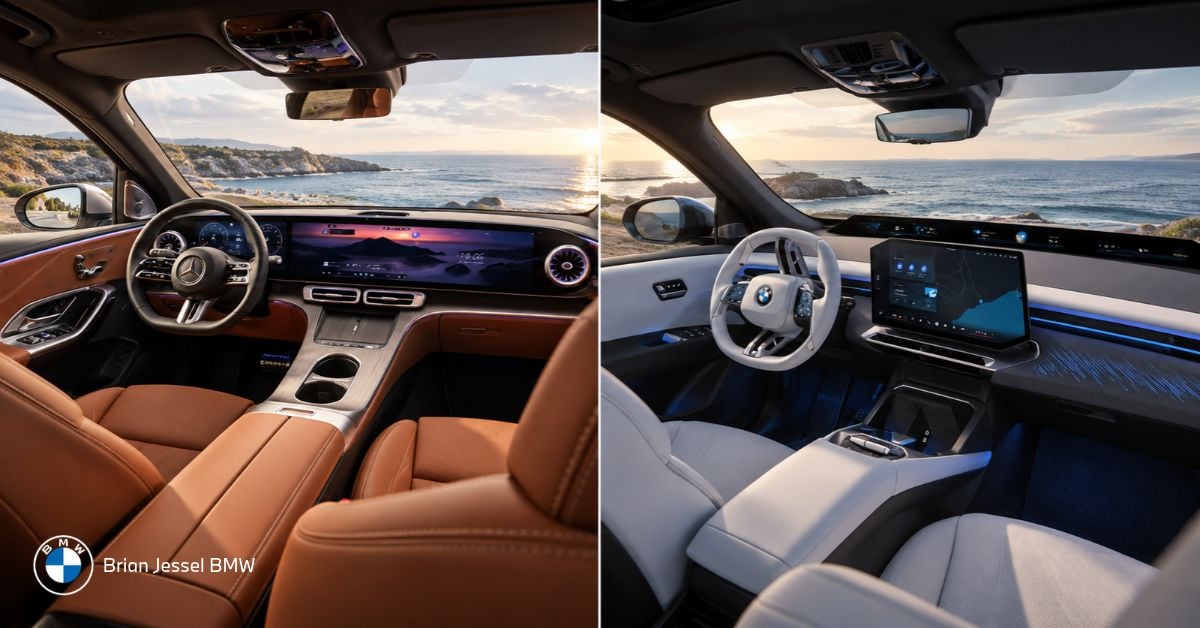
Interior Technology, Dashboard Layout & Cabin Luxury
- BMW combines Panoramic Vision with a 17.9-inch Central Display. 4
- Mercedes offers an available 39.1-inch MBUX Hyperscreen. 2
- Both provide a front storage compartment. 2
BMW Panoramic Vision vs. Mercedes Hyperscreen
BMW Panoramic Vision displays customizable information across the lower windshield area and works with a 17.9-inch Central Display. A separate BMW 3D Head-Up Display is optional. 4
Mercedes takes a more screen-centred approach with its available 39.1-inch MBUX Hyperscreen, described by Mercedes-Benz Canada as its largest continuous screen to date. The GLC also uses MB.OS with the fourth generation of MBUX. 2
Mercedes places more emphasis on one large dashboard display, while BMW divides information between its central screen and the lower windshield area. The better layout comes down to driver preference.
Cargo Space & Frunk Storage
BMW Canada lists 520 L of luggage capacity, increasing to 1,750 L with the rear seats folded, plus 58 L beneath the hood. The rear seats use a 40/20/40 split. 4
Mercedes-Benz Canada lists 570 L of rear luggage space, 1,220 L with the rear seats folded and 128 L in the front trunk. By comparison, BMW Canada lists 520 L of rear luggage space, 1,750 L with the rear seats folded and 58 L beneath the hood.9
Based on these published Canadian figures, the Mercedes has more rear luggage room with the seats upright and a larger frunk, while BMW lists greater maximum rear cargo capacity with the seats folded. Buyers should check the measurement methods and the vehicles in person when comparing usable cargo space.
Final Verdict: Which Luxury EV SUV Should You Buy in North Vancouver?
Choose the Mercedes GLC 400 4MATIC Electric if: You prioritize higher published horsepower and torque, quicker manufacturer-stated acceleration, a larger frunk, rear-seat-up cargo capacity or the available 39.1-inch MBUX Hyperscreen. Its 330 kW DC charging capability and estimated 22-minute 10–80% charging time are also competitive.
Choose the BMW iX3 50 xDrive if: You prioritize its confirmed NRCan-certified range of up to 698 km, higher 400 kW maximum DC charging rate, standard xDrive all-wheel drive and Heart of Joy chassis-control system. Its confirmed $75,900 Canadian starting MSRP also provides a clear reference for budgeting.
For North Vancouver buyers, both SUVs offer compelling electric performance and technology. BMW provides a confirmed Canadian range and starting price, while Mercedes offers stronger published acceleration figures and several interior-practicality advantages. The better choice depends on driving priorities, equipment preferences and the final Canadian pricing of comparable configurations.
Vancouver drivers interested in the BMW can review the BMW EV lineup or check the iX3 test-drive event for an opportunity to see the vehicle in person.
Frequently Asked Questions (FAQ)
1. Which charges faster, the BMW iX3 or the Mercedes GLC EV?
The BMW iX3 has the higher published maximum DC charging rate at 400 kW, compared with 330 kW for the Mercedes GLC 400 4MATIC Electric. BMW estimates a 10–80% charge in as little as 21 minutes, while Mercedes-Benz Canada lists 22 minutes. Actual charging performance depends on charger compatibility, battery conditions and temperature.
2. Is the BMW iX3 or Mercedes GLC EV better suited for Vancouver winter driving?
There is not enough Canadian model-specific winter testing to name a clear winner. The BMW has standard xDrive and a confirmed NRCan range of up to 698 km, while winter tires remain important on designated B.C. routes.
3. How do the driver displays compare between the iX3 and GLC EV?
BMW combines Panoramic Vision with a 17.9-inch Central Display. Mercedes offers an available 39.1-inch MBUX Hyperscreen. BMW puts more information near the windshield; Mercedes emphasizes one large dashboard display.
4. Does the BMW iX3 have a front trunk (frunk)?
Yes. BMW Canada lists 58 L of storage beneath the hood. Mercedes-Benz Canada also confirms front storage and lists 128 L for the electric GLC.
Source:
- BMW Group Canada — BMW Group Canada Announces Pricing and Exceptional Range for the All-New 2027 BMW iX3 50 xDrive
- Mercedes-Benz Canada — 2027 Electric Mercedes-Benz GLC SUV
- BMW Group Canada — The Start of a New Era: The All-New BMW iX3
- BMW Canada — BMW iX3 Overview, Specifications and Equipment
- BMW Group Canada — BMW iX3 Next-Generation Innovations at CES 2026
- Government of British Columbia — PST 116: Motor Vehicle Dealers and Leasing Companies
- Natural Resources Canada — Electric Vehicle Range in Extreme Cold
- Government of British Columbia — Designated Winter Tire and Chain Routes
- Mercedes-Benz Canada — 2027 GLC 400 4MATIC Electric SUV Specifications