Why Does My BMW Need a Wheel Alignment After Spring Pothole Season?
Why Does My BMW Need a Wheel Alignment After Spring Pothole Season?
Posted on September 3, 2026
A significant pothole strike can disturb wheel alignment or damage a tire, rim, steering part or suspension component. Your BMW may not need an adjustment after every minor road impact, but it should receive a BMW alignment check after a hard strike or when the steering wheel becomes off-centre, the vehicle pulls, the tires wear unevenly or a vibration begins.
BMW Group Canada specifications for the 2025 BMW 3 Series and 2025 BMW X3 list double-joint front axles and five-link rear axles with lightweight aluminium or aluminium-steel construction. These examples show why alignment specifications must be matched to the exact BMW model rather than applied across the entire model range.
When an impact changes the position of a wheel or damages a related part, the result may include accelerated tire wear, an off-centre steering wheel or less accurate straight-line tracking.
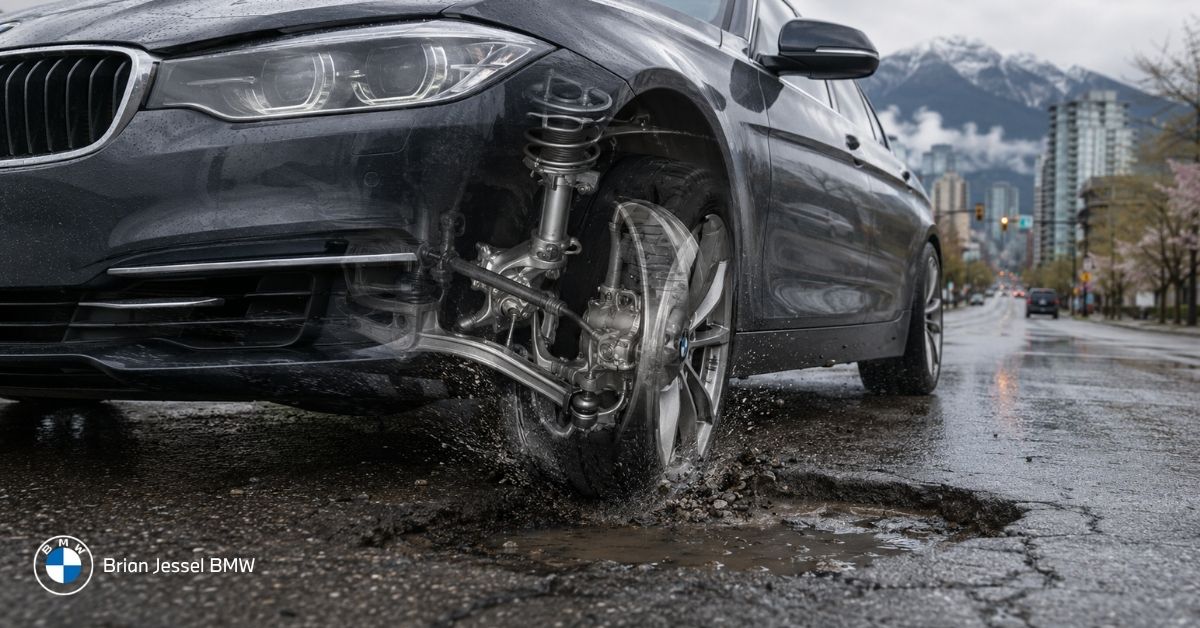
Why Potholes Alter BMW Suspension Geometry: The Physics of Spring Alignment
Vancouver freeze-thaw conditions can contribute to potholes and damaged road surfaces. When a moving wheel hits a sharp pothole edge, the sudden load passes through the tire and rim into the steering and suspension, where it can damage a component or leave the wheel angles outside specification.
For drivers travelling on Boundary Road, Highway 1 approaches, the Knight Street Bridge or other Metro Vancouver routes, a significant pothole impact can justify an alignment check even when the previous alignment was completed recently.
Michelin Canada recommends checking alignment after a significant pothole strike, curb impact or minor collision, especially when steering or tire symptoms appear.
Direct Impact Force Through the Wheel and Steering Components
A pothole impact places a sudden load on the tire and wheel. That load can damage the tire or rim and may disturb alignment if a connected steering or suspension component moves or is damaged.
Toe describes the difference between the distance across the front and rear of two tires on the same axle. Camber is the inward or outward tilt of a wheel from vertical. Incorrect toe can produce feathered tread wear, while incorrect camber or toe may contribute to one-sided wear and pulling.
BMW Suspension Geometry and Lightweight Suspension Parts
BMW Group Canada specifications for the 2025 BMW 3 Series and 2025 BMW X3 illustrate how suspension construction and geometry vary by BMW model.
Because these systems differ, a spring alignment must use the specifications for the exact BMW model, chassis, suspension and fitted equipment rather than a general assumption about suspension stiffness.
Camber and Toe Angles After Vancouver Spring Pothole Damage
Pothole damage is not always visible from outside the vehicle. Alignment may be outside specification, or the tire, rim, steering or suspension may require inspection even when the vehicle remains driveable.
An alignment should not be treated as a substitute for a mechanical inspection. Tire pressure, tire condition, rims and relevant steering and suspension parts should be checked before adjustments are made.
Signs Your BMW Needs an Alignment After Hitting a Pothole
Arrange an inspection when a symptom appears after the impact or continues after tire pressures have been checked. A sidewall bulge, continuing pressure loss, strong pull or significant vibration requires prompt professional attention.
- Crooked Steering Wheel: An off-centre steering wheel while travelling straight can indicate incorrect wheel angles. Road slope, tire pressure and tire condition must also be considered.
- Vehicle Pulling or Drifting: Persistent pulling on a reasonably flat road can indicate misalignment, although unequal tire pressure, uneven tire wear or a brake problem can produce similar symptoms.
- Tire Scrubbing and Uneven Wear: Feathering is associated with toe misalignment, while one-sided wear can indicate that wheel alignment should be checked.
- Steering Wheel Vibration: Vibration is more commonly associated with wheel imbalance or tire and rim damage than alignment alone. An impact can cause more than one problem at the same time.
Post-Pothole BMW Alignment Symptoms and Urgency |
|||
| Alignment Symptom | Possible Mechanical Cause | Effect on BMW Handling or Safety | Recommended Timing |
| Off-Centre Steering Wheel | Wheel Angles Outside Specification | Reduced Straight-Line Accuracy and Possible Tire Wear | Arrange a Prompt Check |
| Vehicle Drift or Pulling | Misalignment, Unequal Tire Pressure, Tire Wear or Brake Drag | Requires Continued Steering Correction | Prompt Inspection; Sooner if Severe |
| Uneven Edge Tread Wear | Toe or Camber Outside Specification | Accelerated Wear on One Part of the Tread | Inspect Before Wear Progresses |
| Steering Wheel Shimmer or Vibration | Wheel Imbalance, Tire Damage or Rim Damage | May Become More Noticeable at Road Speed | Prompt Inspection After an Impact |
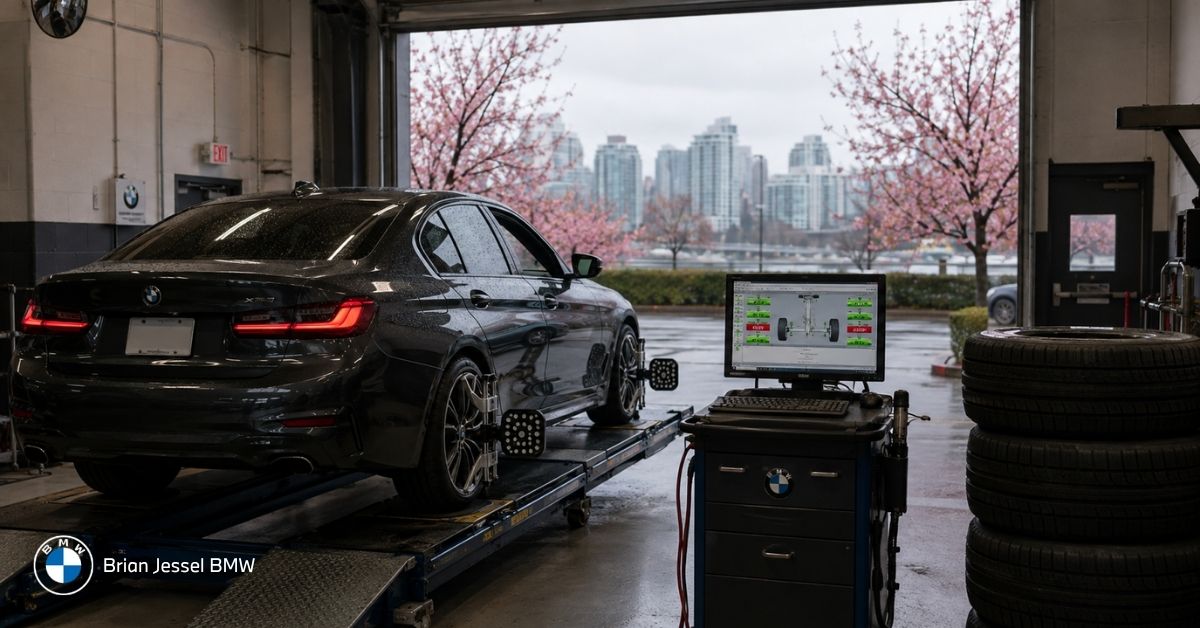
How Often to Align Tires on a BMW in Metro Vancouver
A yearly alignment check is a practical general baseline for Canadian driving, with an additional check after a significant pothole strike, curb impact, new tire installation or a change in steering or tire wear. The need for an actual adjustment depends on the measurements.
Michelin Canada states that most manufacturers recommend checking alignment once a year and after a significant impact. It also identifies spring, after the worst of pothole season, as a practical time for Canadian drivers to have the alignment checked.
Do not wait for the yearly check when the vehicle behaves differently after an impact. Incorrect alignment can accelerate inner-edge or outer-edge wear, including wear that may not be immediately visible while the vehicle is parked.
The spring change from winter tires to summer or all-season tires is a practical time for a BMW alignment check because all four tires can be inspected for irregular inner- or outer-edge wear. A timely check can also help protect costly BMW summer, all-season or performance tires from premature wear.
Learn More: When to Switch to Winter Tires in Vancouver
Why BMW Alignment Service at Brian Jessel BMW Goes Beyond a Basic Alignment
A limited front-wheel adjustment may not address a problem involving rear-wheel geometry. BMW technical documentation includes KDS procedures in which front and rear axle alignment is checked against applicable settings and tolerances. The exact measurements, adjustments and preparation steps depend on the BMW model and the work being performed.
Brian Jessel BMW’s Boundary Road service centre states that it has more than 40 certified, factory-trained technicians and uses BMW-approved diagnostic tools and specialized equipment.
BMW-Specific Wheel Alignment Procedures and Equipment
BMW alignment procedures use model-specific vehicle data and applicable measurements to evaluate wheel geometry against BMW specifications. BMW technical documentation also identifies KDS wheel-alignment procedures that incorporate ride-height measurement, although the equipment and procedure used depend on the vehicle and service facility.
The important distinction is not the KDS name alone. The technician must use the correct vehicle data and follow the applicable procedure for the BMW model, chassis, suspension and fitted equipment. Required measurements and adjustments vary by vehicle.
BMW Ride Height and Model-Specific Loading Procedures
Ride height matters because suspension position can affect wheel-angle readings. BMW alignment procedures do not use one universal ballasting method for every model.
Depending on the BMW model and applicable repair procedure, alignment may account for ride height through measurement, specified loading or both. The technician should follow the instructions for the exact vehicle rather than applying one loading rule to every BMW.
Steering Angle, DSC and xDrive Checks
After the mechanical alignment, the technician should complete any steering-angle or chassis-system procedure required by the applicable BMW repair instructions. Any required steering-angle or chassis-system procedure depends on the BMW model, installed systems and work performed.
BMW Group Canada states that the fully electric xDrive system used in the BMW iX and BMW i4 M50 works with Dynamic Stability Control (DSC). DSC analyses information including wheel speeds, steering angle, driving speed, longitudinal and lateral acceleration, and yaw rate.
Correct mechanical geometry and completion of any required model-specific diagnostic procedures are therefore both relevant.
Frequently Asked Questions: Spring Alignment & BMW Alignment Check
1. Should I get an alignment immediately after hitting a pothole?
Arrange a prompt check after a hard strike or any new pull, vibration, pressure loss, tire bulge or steering change.
2. When is an alignment needed on a BMW?
An adjustment is needed when measurement shows that an adjustable wheel angle is outside the applicable BMW specification.
3. How often should I align tires on a BMW driving in Vancouver?
Use a yearly check as a general baseline and check sooner after a significant impact, new tires or steering and wear symptoms.
4. Can a single pothole ruin my BMW’s tires?
Yes. A severe impact can damage internal tire cords, create a sidewall bulge or cause pressure loss.
5. What is the difference between a standard alignment and a BMW KDS alignment?
A BMW KDS procedure uses BMW-specific vehicle data and equipment to measure applicable wheel geometry. The exact measurements and adjustments depend on the model; the KDS name alone does not mean that every BMW follows one identical procedure.
Book a Post-Pothole BMW Alignment Check in Vancouver
A spring alignment check can determine whether your BMW requires wheel-angle adjustment or further inspection of a tire, rim, steering part or suspension component. Book your post-pothole BMW alignment check with the certified, factory-trained service team at Brian Jessel BMW on Boundary Road in Vancouver.