Best BMW for Towing: BMW Towing Capacity Guide
Best BMW for Towing: BMW Towing Capacity Guide
Posted on April 9, 2026
Towing capacity matters more than many luxury SUV buyers expect. In Vancouver, a BMW may need to handle a boat headed to Horseshoe Bay, a travel trailer bound for the Okanagan, or winter driving through the Coquihalla with a loaded utility trailer.
BMW’s Sports Activity Vehicles are engineered for more than city commuting. When properly equipped, several models deliver serious towing capability while maintaining the road manners and stability the brand is known for.
BMW towing capacity isn’t just a number. It shows how much weight each model can safely pull under real conditions. This includes understanding the equipment needed, comparing how different models perform, and factoring in Vancouver’s roads, weather, and terrain to make the right towing choice.
Note: BMW refers to its SUVs as Sport Activity Vehicles (SAVs), emphasizing performance and on-road dynamics. For clarity, this guide uses “SUV”, the term most drivers recognize, when discussing BMW’s off-road-capable models.
What Is BMW Towing Capacity?
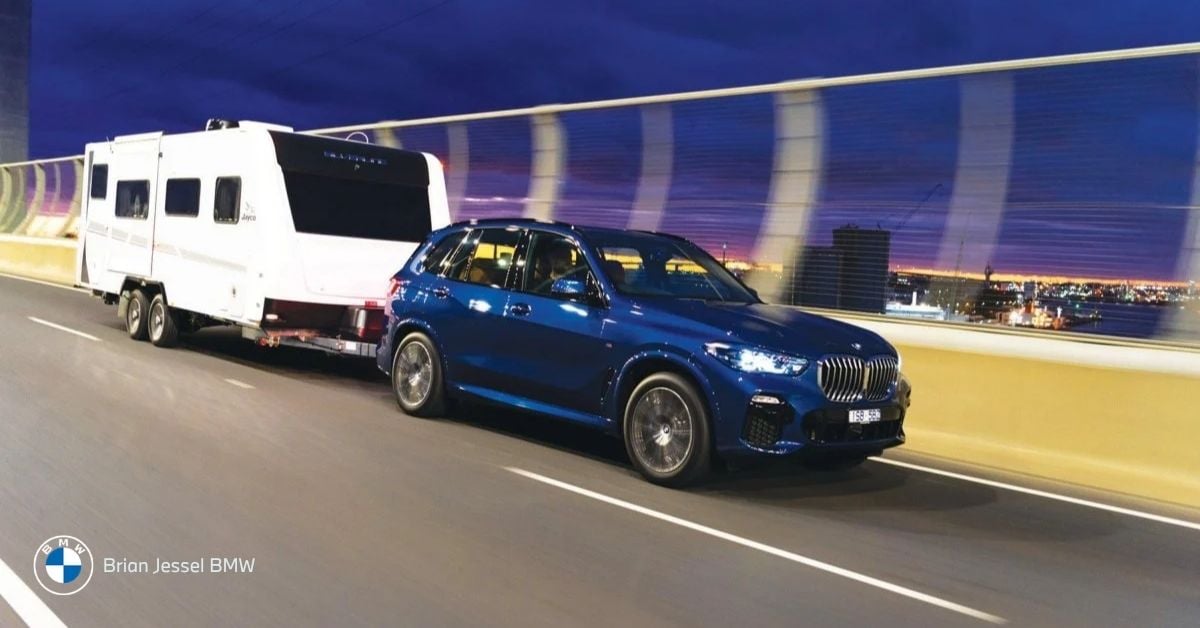
BMW towing capacity is the maximum trailer weight a specific BMW model can safely pull when properly equipped.
“Properly equipped” is essential. The published towing rating assumes a factory-installed trailer hitch, integrated wiring harness, correct cooling system, and software calibrated for towing. Without those components, the official rating does not apply.
Towing capacity refers only to the trailer and its contents. It does not include passengers or cargo inside the vehicle.
Key Towing Terms Explained Clearly
To understand towing properly, you also need to understand several related terms.
➤ Payload capacity is how much weight your BMW can carry inside the vehicle. This includes passengers, luggage, and the downward pressure from the trailer, known as tongue weight.
➤ GVWR (Gross Vehicle Weight Rating) is the maximum safe weight of the vehicle itself when fully loaded.
➤ GCWR (Gross Combined Weight Rating) is the maximum combined weight of the fully loaded vehicle and the fully loaded trailer.
➤ Tongue weight is typically 10–15% of total trailer weight. A 5,000 lb trailer should place roughly 500–750 lbs on the hitch. That weight counts toward payload.
If any of these limits are exceeded, braking performance, stability, and drivetrain durability are compromised.
Why Torque and AWD Matter for Towing in BC
Vancouver driving conditions include heavy rainfall, slippery boat launch ramps, snow in mountain passes, and steep grades along the Sea-to-Sky corridor. These factors directly affect how a vehicle performs while towing.
Torque is the engine’s pulling force. When towing uphill toward Whistler or merging onto Highway 1 with a loaded trailer, torque determines how smoothly the vehicle moves under load. Horsepower affects speed. Torque moves weight.
BMW’s xDrive all-wheel-drive system continuously adjusts power between the front and rear axles. Under load, this improves traction on wet pavement, reduces wheelspin when climbing, and increases control on uneven or slippery surfaces.
For towing in BC, AWD improves stability and driver confidence, especially when the trailer adds weight to the rear axle. In Vancouver conditions, AWD is not a luxury feature. It is a stability feature.
Which BMW Models Are Best for Towing?
BMW towing capability is found primarily in its Sports Activity Vehicle (SAV) lineup, including compact models, midsize SUVs, and select electric vehicles. Capacity depends on vehicle size, wheelbase length, torque output, drivetrain, and whether a factory towing package is installed. xDrive all-wheel drive improves traction in wet or steep BC conditions. Engine type matters, but structural design and cooling systems ultimately determine true towing capability.
Below is a model-by-model analysis, organized by vehicle category and real-world use. These models are not ranked. The right choice depends on what you tow, how often you tow, and how far you travel.
BMW X1 Towing Capacity
Vehicle Type: Compact SAV – The BMW X1 is the smallest Sports Activity Vehicle in the BMW lineup. Its shorter wheelbase, lighter curb weight, and compact footprint prioritize efficiency and city maneuverability rather than heavy towing stability.
Maximum Towing Capacity (Properly Equipped): Up to 1,587 kg (3,500 lbs) depending on configuration.
Required Configuration: Optional factory towing equipment and approved hitch hardware.
What This Means: The X1 supports light-duty recreational towing, including:
- small utility trailers
- lightweight camping trailers
- small personal watercraft
- compact cargo trailers
Heavier dual-axle travel trailers or larger recreational boats would exceed the vehicle’s safe towing range.
Engine & Powertrain Influence: The X1 xDrive28i uses a 2.0L turbocharged four-cylinder engine paired with BMW’s xDrive all-wheel drive system and a 7-speed dual-clutch transmission.
While horsepower supports acceleration, the available torque helps the vehicle launch smoothly when pulling lighter trailers.
Stability & Handling: Because the X1 has a shorter wheelbase and lower curb weight than larger SAV models, towing stability at highway speeds is more limited when operating near maximum capacity.
This makes it best suited to shorter towing distances and lighter loads.
Best Use Case
- Light recreational towing
- Small utility trailers
- Occasional weekend trips
- Drivers prioritizing compact size and efficiency
BMW X3 Towing Capacity
Vehicle Type: Compact SAV
Shorter wheelbase and lighter curb weight improve urban manoeuvrability but reduce long-distance trailer stability compared to midsize and full-size models.
Maximum Towing Capacity (Properly Equipped): 2,200 kg (4,850 lbs) / Payload: 606 kg (1,336 lbs)
Required Configuration: Factory-installed towing equipment.
What This Means: The X3 supports small fishing boats, lightweight campers, single-axle travel trailers, and utility trailers. It is not suited for heavier dual-axle campers or larger enclosed trailers.
Engine & Powertrain Influence: The vehicle is powered by a 2.0L inline-four engine paired with an 8-kW motor and a 0.50-kWh battery system, producing 255 horsepower at 4,700 rpm and 295 lb-ft of torque at 1,600 rpm. Power is delivered through an 8-speed automatic transmission with all-wheel drive.
The higher M50 xDrive trim features a 3.0L inline-six engine, generating 393 horsepower and 428 lb-ft of torque. The fuel tank capacity is 65 litres.
Stability & Handling: The curb weight is approximately 1,894 kg (4,176 lbs). Its shorter wheelbase and lighter mass limit high-speed trailer stability when operating near the maximum rating, making it more suitable for moderate loads.
Best Use Case:
- Urban drivers
- Light recreational use
BMW iX Towing Capacity
Vehicle Type: Electric SAV – The BMW iX is BMW’s fully electric midsize SAV. Its electric powertrain delivers instant torque, which helps when launching a trailer from a stop or climbing steep grades.
Electric SUVs such as the BMW iX demonstrate that towing capability is no longer limited to gasoline-powered vehicles.
Maximum Towing Capacity (Properly Equipped): Up to 2,500 kg (5,511 lbs) depending on configuration.
Required Configuration: Factory towing equipment and integrated trailer wiring system.
What This Means: With a towing rating around 2,500 kg, the iX can handle:
- mid-size utility trailers
- small to mid-size travel trailers
- recreational boats
- outdoor equipment trailers
However, heavy dual-axle campers or large boats would exceed its recommended towing range.
Engine & Powertrain Influence: Electric motors deliver instant torque from zero RPM, which improves low-speed pulling power and hill starts when towing.
However, towing significantly increases energy consumption and reduces driving range compared with normal driving conditions.
Stability & Handling: The iX’s low center of gravity, created by the floor-mounted battery pack, helps maintain stability while towing.
Its curb weight and long wheelbase also improve highway composure compared with smaller vehicles.
Best Use Case
- Drivers wanting electric driving with moderate towing ability
- Recreational towing within EV range limits
- Outdoor equipment and weekend travel
BMW X5 Towing Capacity
Vehicle Type: A midsize SAV offers longer wheelbase, higher curb weight, and stronger suspension, improving towing composure.
Maximum Towing Capacity (Properly Equipped): 2,700–3,270 kg (5,953–7,200 lbs) depending on configuration.
Payload varies by trim and equipment. For example, the X5 xDrive50e plug-in hybrid is commonly rated at 2,700 kg, while certain gasoline-powered X5 configurations can reach up to 3,270 kg when properly equipped with BMW’s factory towing equipment.
Required Configuration: Factory-installed towing equipment and wiring harness.
What This Means: Depending on configuration, the X5 supports mid-size travel trailers, 20 to 22 ft recreational boats, campers, and equipment trailers. Lower-rated trims such as the xDrive50e remain suitable for substantial recreational towing, while higher-rated configurations provide more headroom.
Engine & Powertrain Influence: The X5 xDrive40i is equipped with a 3.0L inline-six engine paired with a 9-kW motor, producing 375 horsepower and 398 lb-ft of torque. Power is delivered through an 8-speed automatic transmission with all-wheel drive.
The X5 xDrive50e plug-in hybrid features a 3.0L inline-six engine paired with a 145-kW electric motor and a 22.13-kWh battery. The system produces a combined 483 horsepower and 516 lb-ft of torque. It has a 69-litre fuel tank and offers an electric driving range of up to 64 kilometres.
Stability & Handling: The X5’s longer footprint and higher curb weight compared to the X3 improve highway tracking, resistance to trailer sway, and stability during lane changes. The M60i’s 553 lb-ft of torque enhances uphill pulling strength, while the xDrive50e’s electric torque provides additional assistance during low-speed launches and incline starts.
Best Use Case:
- Regular towing from moderate loads up to higher-capacity recreational setups, depending on configuration
- Family camping setups
- BC highway travel
- Mountain grades
- Balanced daily usability and towing strength
BMW X6 Towing Capacity
Vehicle Type: A performance midsize SAV, which shares its underlying platform with the X5 but adopts a coupe-style roofline. Wheelbase and drivetrain capability remain similar to the X5.
Maximum Towing Capacity (Properly Equipped): up to 3,270 kg (7,200 lbs) depending on configuration.
Actual towing capacity varies by trim and equipment, but properly equipped X6 models are rated among the highest in BMW’s midsize SAV lineup.
Required Configuration: Factory-installed towing equipment.
What This Means: This means the vehicle supports mid-size travel trailers, recreational boats, dual-axle campers, and equipment trailers. However, cargo volume is lower than the X7 due to its sloping roofline.
Engine & Powertrain Influence: The xDrive40i is equipped with a 3.0L inline-six engine paired with a 9-kW motor, producing 375 horsepower and 398 lb-ft of torque. The M60i xDrive generates 523 horsepower and 553 lb-ft of torque. Both models feature an 83-litre fuel tank, an 8-speed automatic transmission, and all-wheel drive.
Stability & Handling: The vehicle has a curb weight of 2,269 kg (5,002 lbs), with an overall length of 4,935 mm, a width of 2,004 mm, and a height of 1,700 mm. Its wheelbase and mass provide solid highway composure, though it is not as stable as the larger X7 when towing heavy loads.
Best Use Case:
- Regular towing under 6,000 lbs
- Drivers prioritizing styling
- Recreational towing with strong torque
Important: The figures shown represent maximum braked towing capacity. Actual towing capability may vary depending on vehicle configuration, installed equipment, and local regulations.
Note: Payload varies by trim and equipment. Figures shown represent typical configurations.
BMW X7 Towing Capacity
Vehicle Type: A full-size SAV provides a longer wheelbase, greater curb weight, and expanded passenger capacity. These physical characteristics improve straight-line stability and reduce trailer sway at highway speeds.
Maximum Towing Capacity (Properly Equipped): up to 3,405 kg (7,507 lbs) depending on configuration.
This makes the X7 the highest-rated towing vehicle in BMW’s current SAV lineup when properly equipped.
Required Configuration: Factory-installed towing package and wiring harness.
What This Means: At up to 3,405 kg (7,507 lbs) when properly equipped, the X7 can handle larger dual-axle recreational trailers, 20 to 24 ft boats, larger camping trailers, and heavier equipment trailers. It is still not intended for fifth-wheel or commercial-grade towing beyond its rated limits.
Engine & Powertrain Influence: The xDrive40i is powered by a 3.0L inline-six engine paired with a 9-kW motor, producing 375 horsepower and 398 lb-ft of torque.
The M60i xDrive features a 4.4L V-8 engine combined with a 9-kW motor, generating 523 horsepower and 553 lb-ft of torque. Both models are equipped with an 83-litre fuel tank, an 8-speed automatic transmission, and all-wheel drive.
Stability & Handling: The M60i has a curb weight of 2,674 kg (5,895 lbs), with an overall length of 5,172 mm, a width of 2,000 mm, and a height of 1,835 mm. Its longer footprint improves highway tracking and helps reduce trailer sway compared to more compact models.
Best Use Case:
- Long-distance towing
- Full passenger loads
- Highway stability priority
- Larger family recreational travel
How to Determine Which BMW Is Right for Your Towing Needs?
If you tow light loads under about 3,500 lbs occasionally, the BMW X1 or X3 can be suitable choices. The X1 supports light-duty recreational towing such as small utility trailers, while the X3 offers more power and stability for slightly heavier loads.
For regular towing up to 5,953 lbs, a midsize SAV like the X5 or X6 is better. Both handle dual-axle travel trailers, mid-size boats, and family camping trips, with the X6 offering sportier styling and the X5 giving more cargo space.
If you need to tow heavier trailers long distances with a full passenger load, the X7 provides the highest stability. Its full-size design improves highway stability, reduces trailer sway, and supports larger recreational trailers.
For those prioritizing efficiency while towing light loads, BMW’s hybrid or plug-in electric options, like the X5 xDrive50e, provide moderate towing with electric torque assistance and better fuel economy.
Always match your trailer weight and towing frequency to the BMW trim to ensure safe and comfortable towing.
Which BMW Is the Best for Towing?
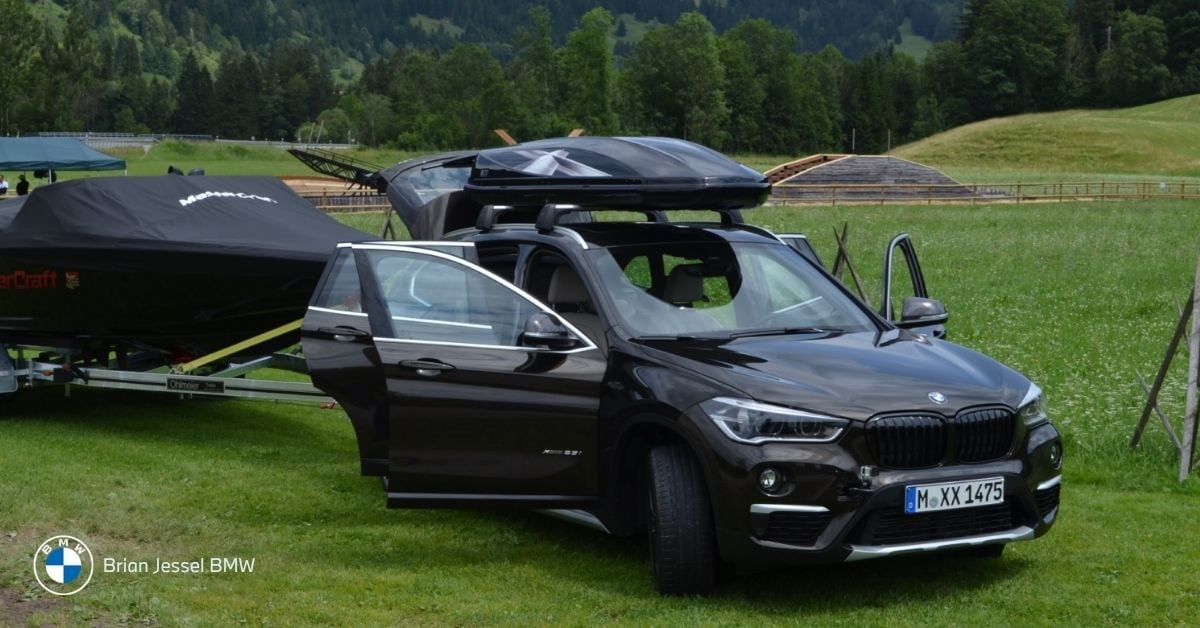
Choosing the right BMW for towing is more than looking at numbers. It depends on the type of load, distance, and conditions. BMW’s Sports Activity Vehicles (SAVs) offer varying combinations of stability, torque, and passenger space, so the “best” choice changes with your needs.
Best BMW for Towing a Boat
For small boats and light trailers, the BMW X1 or X3 can handle light loads efficiently. Its compact size and maneuverability make it ideal for boat ramps and urban storage, while still providing enough power for single-axle trailers. For larger recreational boats, the X5 or X6 is more suitable. Their longer wheelbases, higher torque, and better highway stability make launching and towing mid-size boats smoother, especially over BC highways or mountain passes.
Best BMW for Towing a Travel Trailer
For occasional towing of small trailers, the X3 is sufficient. However, if you plan to tow regularly or use dual-axle travel trailers, the X5 or X6 offers the right balance of towing strength and comfort. The X5’s upright design provides more cargo space for gear, while the X6 adds a sportier aesthetic without sacrificing towing performance. The X7 steps in when full passenger capacity or larger trailer stability is a priority.
Best BMW for Towing in Winter (Vancouver Conditions)
BC winters demand traction more than raw power. All BMW xDrive models improve stability on wet, snowy, or steep roads, but the X5 and X7 are standout options. Their longer wheelbases, heavier curb weights, and advanced all-wheel-drive systems reduce trailer sway and make towing on slippery roads safer. The X3 remains capable for light towing, but high-speed highway stability with a trailer is best handled by a midsize or full-size SAV.
Best BMW for Maximum Towing Capacity
While several BMW SAV models offer strong towing capability, the X7 provides the highest maximum towing rating in the current lineup.
Properly equipped X5 and X6 models can tow up to 3,270 kg, while the larger X7 reaches approximately 3,405 kg, giving it a slight advantage for maximum-capacity towing.
Its combination of 553 lb-ft of torque, long wheelbase, and full-size body ensures stability even with a fully loaded trailer and passengers. While BMW’s towing limits remain below heavy-duty pickup-truck territory, the X7 maximizes control, comfort, and safety for heavier recreational towing scenarios over long distances.
BMW Towing Capacity Comparison Chart
Understanding towing numbers is about more than just raw pounds. Maximum towing capacity shows the heaviest trailer a BMW can safely pull when properly equipped, including a factory hitch, wiring, cooling, and calibrated software.
Exceeding these limits, or ignoring payload and tongue weight, can compromise stability, braking, and drivetrain durability. Torque and all-wheel drive are especially important in Vancouver conditions, where wet roads, boat ramps, and steep mountain grades test control.
| Model | Max Towing Capacity | Engine Type | Drivetrain | Torque (Nm) | Best Use Case |
| BMW X1 | 1,587 kg (3,500 lbs) | 2.0L Turbo I-4 | xDrive AWD | ~400 Nm | Light Utility & Small Trailers |
| BMW X3 | 2,200 kg (4,850 lbs) | 2.0L I-4 Hybrid / 3.0L I-6 (M50) | xDrive AWD | 400 Nm (I-4) / 580 Nm (M50) | Light Recreational Towing, Urban Use |
| BMW iX | 2,500 kg (5,511 lbs) | Dual Electric Motors | AWD | Up to ~1,015 Nm | EV Towing & Recreational Gear |
| BMW X5 | up to 3,270 kg (7,200 lbs) | 3.0L I-6 Mild Hybrid / Plug-In Hybrid / V8 | xDrive AWD | 540 Nm (40i) / 700 Nm (50e) / 750 Nm (M60i) | Family Camping, Mountain Travel |
| BMW X6 | up to 3,270 kg (7,200 lbs) | 3.0L I-6 Mild Hybrid / 4.4L V8 | xDrive AWD | 540 Nm (40i) / 750 Nm (M60i) | Recreational Towing with Sport Styling |
| BMW X7 | up to 3,405 kg (7,507 lbs) | 3.0L I-6 Mild Hybrid / 4.4L V8 | xDrive AWD | 540 Nm (40i) / 750 Nm (M60i) | Long-Distance Towing, Full Passenger Loads |
Published towing capacities depend on trim, drivetrain, and installed towing equipment. Always confirm the exact rating for the specific BMW configuration before towing near maximum limits.
About These Numbers
- Towing Capacity (kg / lbs)
This refers to the maximum trailer weight the vehicle can safely pull when properly equipped. A capacity of around 2,200 kg is suited to light-duty towing such as small boats and single-axle campers. A rating of around 2,700 kg moves into mid-size travel trailers, dual-axle campers, and larger recreational boats. None of these models are designed for heavy fifth-wheel or commercial-grade towing. Ratings above 3,200 kg provide additional headroom for heavier recreational trailers and larger boats, especially on longer BC highway routes.
- Engine Type
Inline-six engines and V8 engines generally provide stronger sustained pulling power than smaller four-cylinder engines. Plug-in hybrid systems add electric torque, which improves low-speed launches and uphill starts when towing.
- Drivetrain (xDrive AWD)
All listed models use xDrive all-wheel drive. In BC conditions, this improves traction when launching a boat on a wet ramp, climbing mountain grades, or driving in rain and snow. It does not increase the rated towing capacity, but it improves control and confidence.
- Torque (Nm)
Torque matters more than horsepower when it comes to towing performance. Around 400 Nm is sufficient for lighter loads and occasional towing. Approximately 540 Nm and above improves highway merging and grade climbing. Figures in the 700 to 750 Nm range provide stronger uphill pulling strength and better composure when towing near maximum capacity.
- Vehicle Size and Stability
Even when towing capacity is identical, physical size plays an important role. The X3 is lighter and shorter, which can limit high-speed trailer stability. The X5 and X6 provide a more balanced platform with a stronger suspension setup and a longer wheelbase. The X7, as the largest and heaviest model, delivers the most stable highway tracking, particularly when carrying full passenger loads.
BMW Towing Packages & Accessories
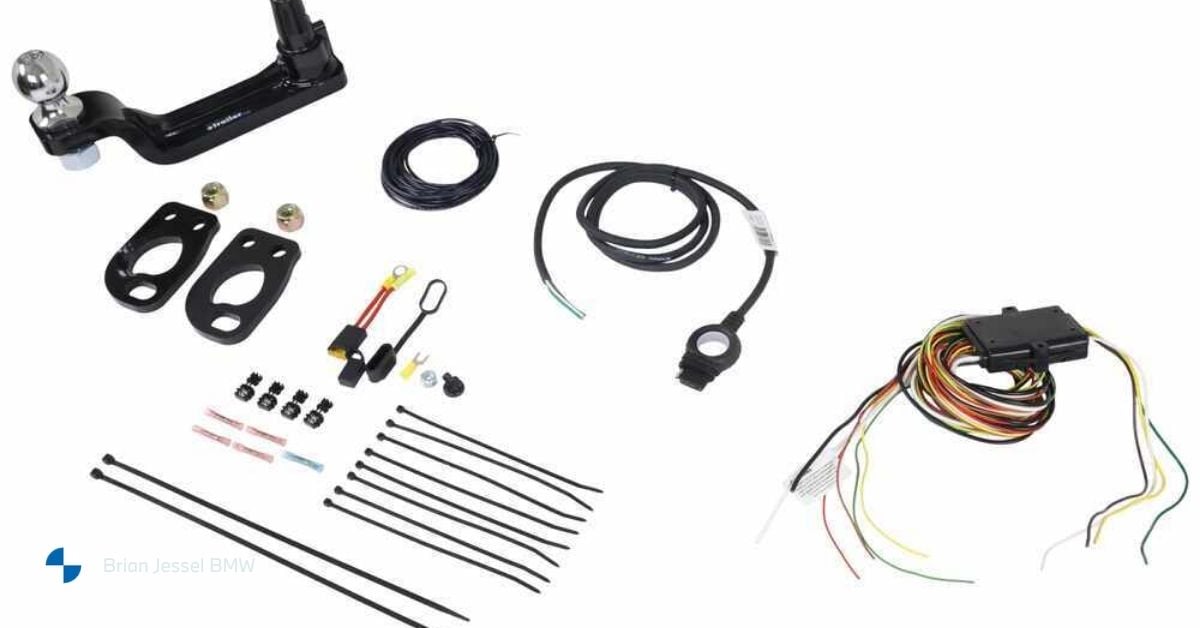
BMW’s maximum towing ratings apply only when the vehicle is equipped with the factory-installed trailer hitch and approved towing hardware.
The factory package includes an integrated hitch receiver, a 7-pin wiring harness, and trailer stability control programming. In some models, it also adds transmission software calibration and cooling adjustments to handle sustained towing loads.
When connected through the factory system, the vehicle detects the trailer and adjusts shift points, braking response, and stability control to manage sway and load dynamics. This integration is especially important for mountain driving and wet conditions in British Columbia.
Factory installation maintains warranty coverage and ensures proper system calibration. Aftermarket hitches may not integrate with BMW’s electronic safety systems and can affect rated capacity and coverage.
Is Towing Safe with a BMW SUV?
Towing with a BMW SUV is safe when the vehicle is properly equipped and operated within its rated limits. Matching trailer weight to capacity and using factory towing equipment are essential. BMW integrates trailer stability control, advanced braking systems, adaptive suspension, and xDrive all-wheel drive.
Trailer sway control helps correct instability, while strong braking systems improve stopping performance under load. xDrive adjusts power between axles to maintain traction on wet, uneven, or snow-covered roads. Proper weight distribution also plays a key role in maintaining steering control and braking stability.
In Vancouver and across British Columbia, steep mountain grades, frequent rain, and winter driving conditions increase the importance of traction and braking performance. Larger models such as the X5 and X7 provide added stability due to longer wheelbases and greater curb weight.
When properly configured and driven within limits, a BMW SUV delivers stable and controlled towing performance in BC conditions.
BMW vs Competitors for Towing
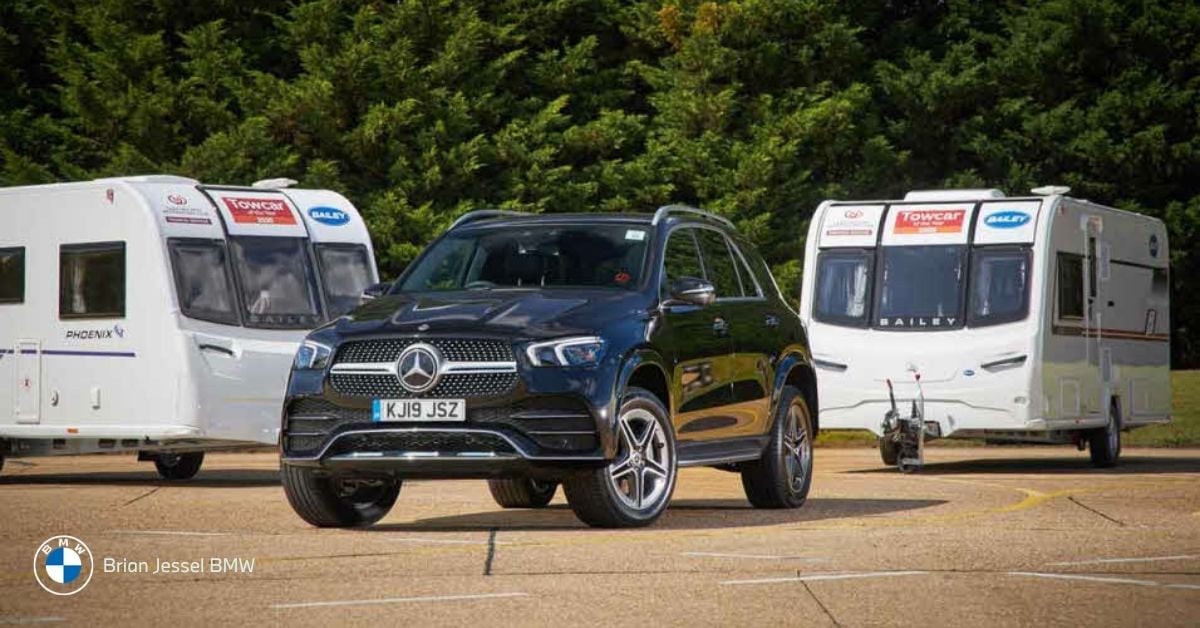
Luxury SUVs such as the Audi Q7, Mercedes-Benz GLE, and Porsche Cayenne all offer capable towing performance in similar weight classes when properly equipped.
The Audi Q7 focuses on refinement and technology, the Mercedes-Benz GLE emphasizes comfort and smooth ride quality, and the Porsche Cayenne leans heavily toward performance driving dynamics.
BMW stands out by balancing strong torque delivery with stable chassis tuning and precise steering feel under load. Even when towing, BMW SAV models maintain responsive handling and consistent feedback through the wheel.
For drivers in British Columbia who tow on winding highways, mountain passes, and coastal routes, this balance between sport-oriented control and practical towing strength is often a key advantage.
How to Choose the Right BMW for Your Towing Needs
Start by determining the fully loaded weight of your trailer. Do not rely on dry weight. Include fuel, water, gear, and cargo to calculate the true load.
Next, consider how often you tow and how far you travel. Occasional short trips allow more flexibility. Frequent or long-distance towing, especially through mountain grades or winter conditions, requires greater stability.
Think about passenger and storage needs. Do you need third-row seating? Will you travel with a full cabin and luggage? Extra weight affects overall capacity and comfort.
Match your trailer weight and usage to the correct SAV category, compact, midsize, or full-size. Choosing the right class based on real conditions matters more than selecting the highest towing number.
Where to Buy the Best BMW for Towing in Vancouver
Finding the right BMW for towing involves understanding vehicle specifications and local driving conditions. Brian Jessel BMW works with drivers who tow boats, campers, and equipment throughout British Columbia.
Their trained advisors are familiar with factory towing configurations, warranty considerations, and the demands of BC terrain, including mountain grades and seasonal weather. Proper specification at the time of purchase helps ensure the vehicle is correctly rated and equipped.
For buyers seeking informed guidance and long-term service support, working with a dealership experienced in local towing requirements provides added confidence.
FAQs
What BMW is best for towing?
The BMW X7 is the strongest overall towing option, offering maximum stability, high torque, and better control for long-distance towing with passengers and heavier recreational trailers.
What BMW can tow 3,500 kg?
No current BMW SUV in Canada is rated for a full 3,500 kg. The highest published towing rating is approximately 3,405 kg for the BMW X7 when properly equipped.
Is the BMW X3 or X5 better for towing?
The X5 tows more, with published towing figures ranging from about 2,700 kg to 3,270 kg depending on configuration, and it offers greater stability and torque. The X3 suits lighter, occasional recreational towing.
Do I need a factory towing package?
Yes. Official towing ratings require the factory hitch, wiring, and calibration to ensure safety, proper stability control, and warranty protection.
Can BMW tow a 20 ft boat?
Yes, a 20 ft boat and trailer can fall within the towing range of the X5, X6, or X7 if the combined loaded trailer weight stays within the rated towing limit of the specific configuration, and tongue weight plus passengers and cargo remain within payload limits.
Do I need trailer brakes?
If your trailer is heavy enough to require brakes under BC regulations or manufacturer recommendations, you should use trailer brakes. Trailer brakes reduce stopping distance and help control sway, especially on steep grades.
Is trailer sway control standard?
BMW integrates stability systems that can help manage trailer dynamics when the vehicle is properly equipped with the factory towing system. The key is the vehicle’s ability to detect the trailer through the correct wiring and programming.